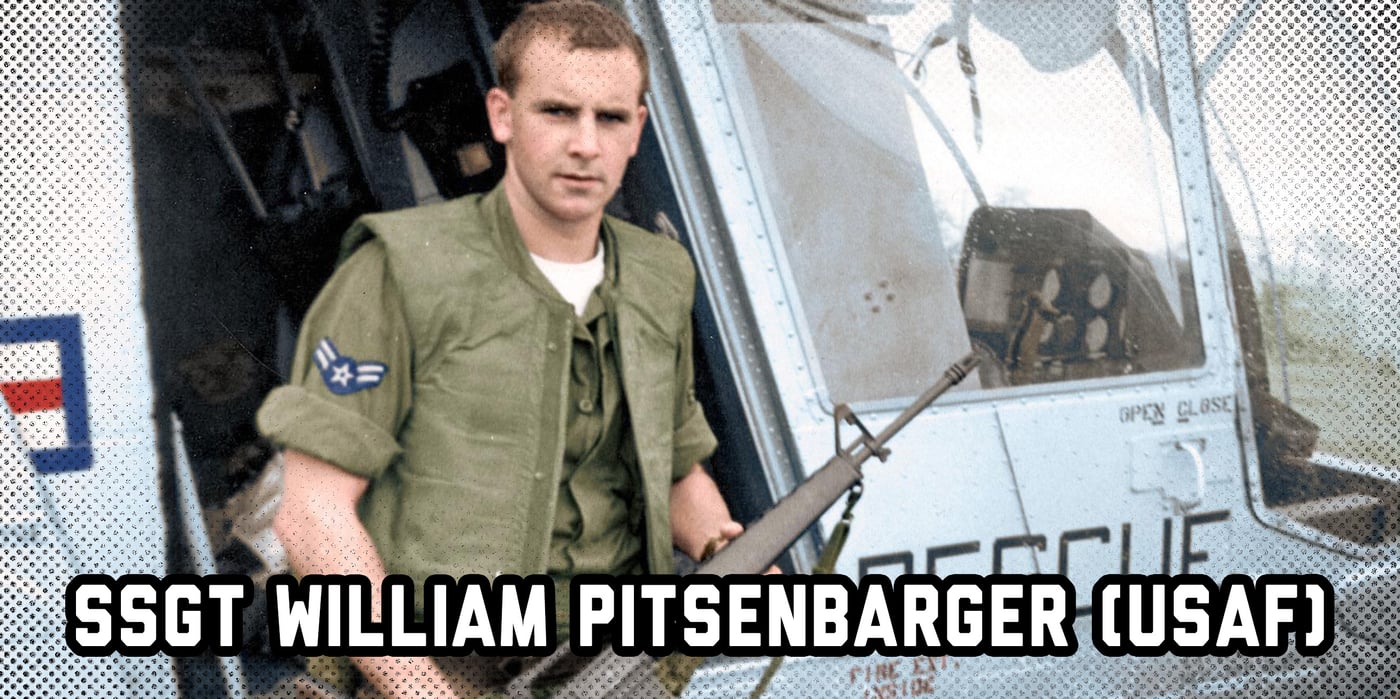

William Hart Pitsenbarger, son of Irene and William, grew up in the small town of Piqua, near Dayton, Ohio. He was a smart and ambitious youngster, and by the time he reached high school, he knew just what he wanted to do.
In his junior year, he wanted to enlist in the Army as a Green Beret, but his parents would not consent to his enlistment before age 18. After he graduated, he changed course, joining the Air Force. On New Year’s Eve 1962, he headed for basic training in San Antonio.
Early on, he volunteered for Pararescue — Parajumpers (PJs) are special operators trained as combat medics and rescue specialists who conduct high-risk rescue and recovery. Their motto is, “These things we do, that others may live.”
Pitsenbarger’s PJ qualification began with extensive training at the Army Airborne School, the Navy Dive School, and then survival schools. He then completed an intensive rescue and survival medical course, followed by Air Force rescue training and jungle-survival schools. His final courses were in air crash rescue and firefighting.
A1C Pitsenbarger was one of the first Airmen to qualify for Pararescue right out of basic training and was assigned to a Rescue Squadron stationed at Hamilton AFB, California.
In August 1965, he was deployed to Vietnam and assigned to Detachment 6, 38th Air Rescue and Recovery Squadron at Bien Hoa Air Base near Saigon. His unit consisted of five aircrews flying three Kaman HH-43F Huskie helicopters. Early on, his commander, Major Maurice Kessler, noted he was “One of a special breed. Alert and always ready to go on any mission.”
Pitsenbarger would fly almost 300 rescue missions to aid soldiers and downed pilots, one of which involved hanging from his HH-43’s cable above a burning minefield in order to rescue a wounded South Vietnamese soldier. That heroic action earned him the Airman’s Medal and the Republic of Vietnam’s Medal of Military Merit and Gallantry Cross.
But it was on 11 April 1966 that his actions would earn him the Medal of Honor.
On that date, the Joint Rescue Center dispatched two HH-43s from Detachment 6 for an extraction rescue of wounded Army soldiers pinned down in battle about 35 miles east of Saigon. A company of 134 1st Infantry Division soldiers was surrounded by more than 500 Viet Cong. Once reaching the site where the American forces had been ambushed, Pitsenbarger was daringly lowered through the jungle canopy to attend to the first of the wounded, and then had them airlifted out.
Back on the ground for a second extraction of wounded Americans, Pitsenbarger “waved off” returning to his helicopter, determined to keep rendering assistance to the remaining infantrymen. He knew his HH-43s could not return because of heavy small-arms fire. Having exhausted his medical supplies, he fashioned splints and stretchers from bamboo and vines. He also collected ammunition from deceased soldiers to resupply those still able to defend their position.
Though Pitsenbarger would be killed after nightfall, his actions ensured that the remaining 60 infantrymen made it out alive.
For his actions, Pitsenbarger received the Air Force Cross and was posthumously promoted to staff sergeant. The Department of Defense then upgraded his Air Force Cross to a Medal of Honor, which his parents accepted on his behalf at a National Museum of the USAF ceremony.
As his MoH citation notes:
With complete disregard for personal safety, Airman Pitsenbarger volunteered to ride a hoist more than one hundred feet through the jungle, to the ground. On the ground, he organized and coordinated rescue efforts, cared for the wounded, prepared casualties for evacuation, and insured that the recovery operation continued in a smooth and orderly fashion. Through his personal efforts, the evacuation of the wounded was greatly expedited. As each of the nine casualties evacuated that day was recovered, Airman Pitsenbarger refused evacuation in order to get more wounded soldiers to safety. After several pick-ups, one of the two rescue helicopters involved in the evacuation was struck by heavy enemy ground fire and was forced to leave the scene for an emergency landing.
His citation continues:
Airman Pitsenbarger stayed behind on the ground to perform medical duties. Shortly thereafter, the area came under sniper and mortar fire. During a subsequent attempt to evacuate the site, American forces came under heavy assault by a large Viet Cong force. When the enemy launched the assault, the evacuation was called off and Airman Pitsenbarger took up arms with the besieged infantrymen. He courageously resisted the enemy, braving intense gunfire to gather and distribute vital ammunition to American defenders. As the battle raged on, he repeatedly exposed himself to enemy fire to care for the wounded, pulled them out of the line of fire, and return fire whenever he could, during which time he was wounded three times. Despite his wounds, he valiantly fought on, simultaneously treating as many wounded as possible. In the vicious fighting that followed, the American forces suffered 80 percent casualties as their perimeter was breached, and Airman Pitsenbarger was fatally wounded.
His citation concludes: “Airman Pitsenbarger exposed himself to almost certain death by staying on the ground, and perished while saving the lives of wounded infantrymen. His bravery and determination exemplify the highest professional standards and traditions of the military service and reflect great credit upon himself, his unit, and the United States Air Force.”
William Pitsenbarger was the sixth enlisted Air Force MoH recipient.
In 2019, his heroic story became a feature film, “The Last Full Measure.”
Of his final mission, David Peters, one of the Charlie Company soldiers who witnessed Pitsenbarger’s actions, declared: “There was only one man on the ground that day that would have turned down a ride out of that hellhole — and that man was Pitsenbarger.”
SSgt William Pitsenbarger: Your example of valor — a humble American Patriot defending Liberty for all above and beyond the call of duty, and in disregard for the peril to your own life — is eternal.
“Greater love has no one than this, to lay down one’s life for his friends.” (John 15:13)
Live your life worthy of his sacrifice.
(Read more Profiles of Valor here.)
Semper Vigilans Fortis Paratus et Fidelis
Pro Deo et Libertate — 1776
[Follow Mark Alexander on X/Twitter.](https://twitter.com/MAlexander1776)
Join us in daily prayer for our Patriots in uniform — Soldiers, Sailors, Airmen, Marines and Coast Guardsmen — standing in harm’s way in defense of American Liberty, honoring their oath “to support and defend” our Constitution. Pray for our Veterans, First Responders, and their families.
Please consider a designated gift to support the National Medal of Honor Sustaining Fund through Patriot Foundation Trust, or make a check payable to “NMoH Sustaining Fund” and mail it to:
Patriot Foundation Trust
PO Box 407
Chattanooga, TN 37401-0407
Thank you for supporting our nation’s premier journal of American Liberty.
The Patriot Post and Patriot Foundation Trust, in keeping with our our Military Mission of Service to our uniformed service members and veterans, are proud to support and promote the National Medal of Honor Heritage Center, the Congressional Medal of Honor Society, both Honoring Their Sacrifice Foundation and Warrior Freedom Service Dogs aiding wounded veterans, Tunnel to Towers Foundation, the National Veterans Entrepreneurship Program, the Folds of Honor outreach and Officer Christian Fellowship, the Air University Foundation and Naval War College Foundation, and the Naval Aviation Museum Foundation.