
On Christmas Eve and Day in 1914, along the World War I Western Front entrenchments near Ypres in Belgium, there were many, albeit unofficial, Christmas ceasefires between combatants.
There were few such pauses in Europe during World War II, but notably, there was a much smaller spot truce during the Battle of the Bulge. Even so, there was no Christmas rest for most combatants.
The Battle of the Bulge (16 December 1944 to 28 January 1945) was the last major German offensive on the Western Front and the largest single battle fought by U.S. forces in World War II. The 16 December surprise attack by NAZI forces against Allied soldiers in the dense Ardennes Forrest in eastern Belgium and northern Luxembourg launched the Axis strategy to both cut off Allied access to the Belgian port of Antwerp and to encircle and destroy the four Allied armies in order to force a treaty.
The German offensive was defeated. Germany committed almost 410,000 men, 1,400 tanks and armored vehicles, 2,600 pieces of artillery, and 1,000 combat aircraft. But by the end of the battle, they had an estimated 104,000 men killed, wounded, missing, or captured. It was the beginning of the end of the NAZI terror.
Of the 700,000 Allied forces, there were an estimated 83,000 casualties, including about 9,000 killed.
This is the story of one American hero among many who fought in the Ardennes.
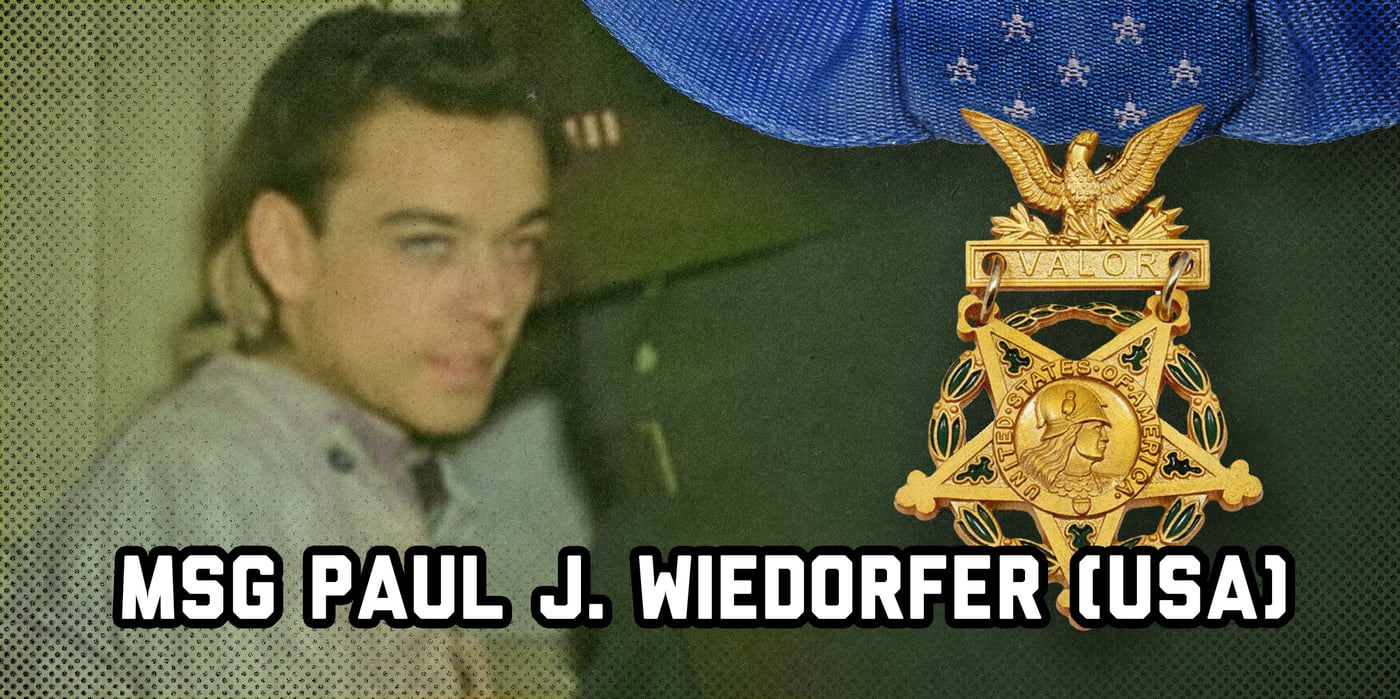
Of the 3,528 Medal of Honor recipients since 1863, only two since the War Between the States received the award for actions on Christmas Day. They were both World War II recipients: Army Master Sergeant Paul J. Wiedorfer and Army Air Corps Major Thomas B. McGuire.
Of the 21 Medals of Honor awarded for actions during the Battle of the Bulge, MSG Wiedorfer’s was for his actions on Christmas Day, 1944, near Chaumont, Belgium.
Paul Wiedorfer was a native of Baltimore, Maryland. He attended St. Andrew’s School and, in 1940, graduated from Baltimore Polytechnic Institute. In 1943, six months after marrying his sweetheart Alice, he joined the Army, completing basic training at Ft. Lee. He then trained as a pilot until the demand for infantry soldiers required him to change course.
After crossing to Europe on the RMS Queen Mary, he was assigned as a rifleman to Company G, 318th Infantry Regiment, 80th Infantry Division. As part of Gen. George S. Patton’s Third Army, he was sent in December 1944 to help rescue American troops trapped in Bastogne, Belgium, during the early days of the Battle of the Bulge.
It was on Christmas Day that then-Private Wiedorfer would charge 150 yards across a bloody field of snow and ice, subjected to a wall of enemy fire, and single-handedly destroy two NAZI machine-gun nests — taking 24 prisoners. By the end of that day, his actions had taken him from the rank of Private to a platoon-leading Sergeant.
Wiedorfer recalls: “Something had to be done, and someone had to do it. And I just did it. I can’t tell you why. I was probably a little nuts when I did it. But someone was going to die if something didn’t get done. Luckily, their firing wasn’t too good that day. They didn’t get me.”
In addition to his rank promotion, in May 1945, while recovering from severe wounds he suffered on 10 February, BG E.F. Koenig presented Paul with a Medal of Honor at the 137th General Hospital, Ellesmere, Shropshire, England.
His Medal of Honor citation describes what Wiedorfer “just did”:
He alone made it possible for his company to advance until its objective was seized. Company G had cleared a wooded area of snipers, and one platoon was advancing across an open clearing toward another wood when it was met by heavy machine-gun fire from two German positions dug in at the edge of the second wood. These positions were flanked by enemy riflemen. The platoon took cover behind a small ridge approximately 40 yards from the enemy position. There was no other available protection and the entire platoon was pinned down by the German fire. It was about noon and the day was clear, but the terrain extremely difficult due to a three-inch snowfall the night before over ice-covered ground.
His citation continues:
Pvt. Wiedorfer, realizing that the platoon advance could not continue until the two enemy machine-gun nests were destroyed, voluntarily charged alone across the slippery open ground with no protecting cover of any kind. Running in a crouched position, under a hail of enemy fire, he slipped and fell in the snow, but quickly rose and continued forward with the enemy concentrating automatic and small-arms fire on him as he advanced. Miraculously escaping injury, Pvt. Wiedorfer reached a point some 10 yards from the first machine-gun emplacement and hurled a hand grenade into it. With his rifle he killed the remaining Germans, and, without hesitation, wheeled to the right and attacked the second emplacement. One of the enemy was wounded by his fire and the other six immediately surrendered. This heroic action by one man enabled the platoon to advance from behind its protecting ridge and continue successfully to reach its objective. A few minutes later, when both the platoon leader and the platoon sergeant were wounded, Pvt. Wiedorfer assumed command of the platoon, leading it forward with inspired energy until the mission was accomplished.
You know, “Something had to be done, and someone had to do it”!
You can listen to Paul narrate the details of his actions here.
When Paul returned to his hometown of Baltimore on 11 June 1945, he received a fitting hero’s welcome and ticker tape parade, with GEN George C. Marshall and Maryland Governor Herbert O’Conor presiding.
After the war, he spent three additional years recovering in different Army hospitals, reaching the rank of Master Sergeant before separating from the Army. He then returned to his first employer before the war, Baltimore Gas & Electric.
A Washington Post profile of Paul concluded: “As he aged, Mr. Wiedorfer said he prayed for the day there would be no living recipients of the Medal of Honor. ‘Because,’ he once said, ‘it will mean that we have learned to live in peace.’” Of the many recipients I have known, all would agree with that statement.
Paul retired in 1981 and died in Baltimore on 25 May 2011 at age 90, three years after his wife Alice died. They were the proud parents of four children, six grandchildren, and three great-grandchildren.
MSG Paul J. Wiedorfer: An ordinary man faced with extraordinary circumstances, he summoned the greatest measure of courage to place his life in imminent peril to save others. Your example of valor — a humble American Patriot defending Liberty for all above and beyond the call of duty — is eternal.
“Greater love has no one than this, to lay down one’s life for his friends.” (John 15:13)
Live your life worthy of his sacrifice.
(Read more Profiles of Valor here.)
Semper Vigilans Fortis Paratus et Fidelis
Pro Deo et Libertate — 1776
[Follow Mark Alexander on X/Twitter.](https://twitter.com/MAlexander1776)
Join us in daily prayer for our Patriots in uniform standing in harm’s way in defense of American Liberty, and for the families awaiting their safe return. Pray also for our Veterans, First Responders, and their families.
The Patriot Post and Patriot Foundation Trust, in keeping with our our Military Mission of Service to our uniformed service members and veterans, are proud to support and promote the National Medal of Honor Heritage Center, the Congressional Medal of Honor Society, both Honoring Their Sacrifice Foundation and Warrior Freedom Service Dogs aiding wounded veterans, Tunnel to Towers Foundation, the National Veterans Entrepreneurship Program, the Folds of Honor outreach and Officer Christian Fellowship, the Air University Foundation and Naval War College Foundation, and the Naval Aviation Museum Foundation.