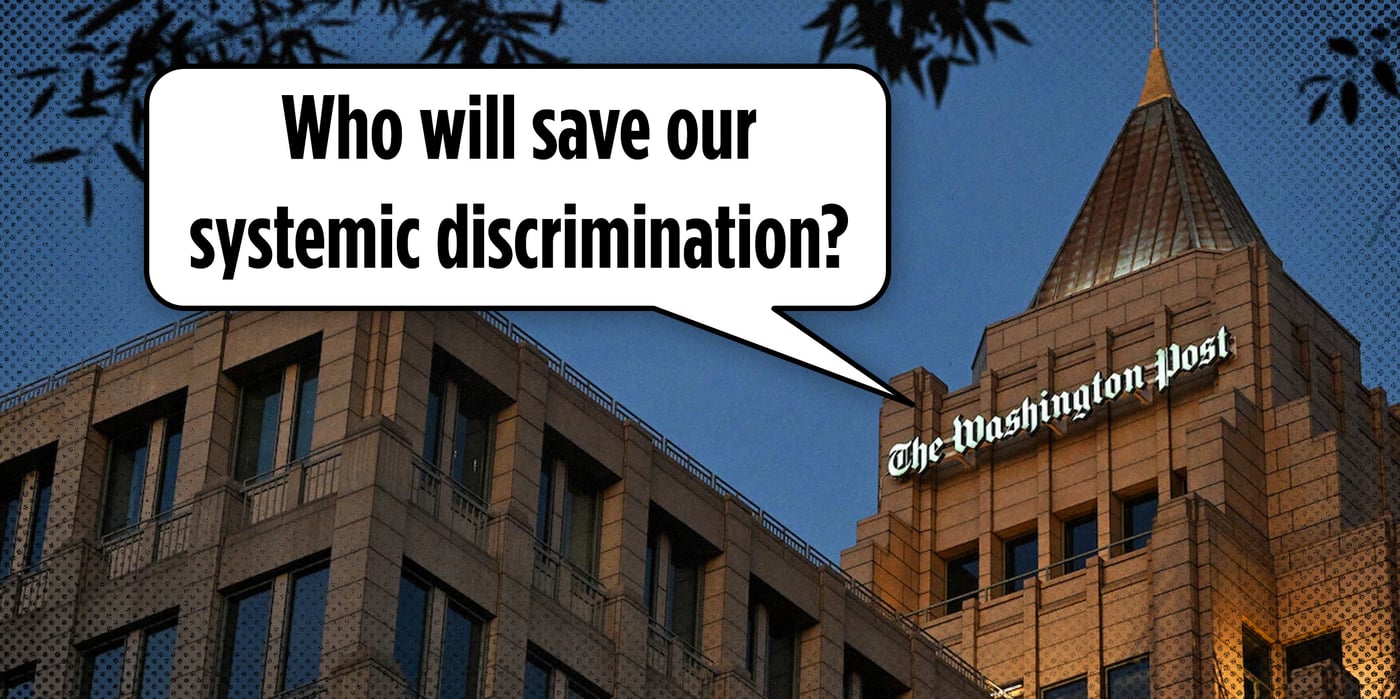

The Washington Post deployed more wailing and gnashing of teeth over President Donald Trump’s ban on Diversity, Equity, and Inclusion (DEI) policies in federally funded universities, decrying that it’s hurting diversity. It is apparent from WaPo’s report that Beltway journalists view “progress” in education as simply more black and brown professors and students, rather than academic excellence and meritocracy.
The Post’s intrepid journalistic trio of authors bemoans that many schools that had been making progress in their diversification programs are now putting them on hold, renaming them, or eliminating them altogether. They write, “Of the 184 universities that made faculty diversity pledges, at least 108 have fully or partially rolled them back, according to a Post survey and analysis of public statements and news coverage.”
They claim the Trump administration is misinterpreting the Civil Rights Act and using it to go after their precious diversity initiatives. I’m afraid they’re the ones that have it backwards. The Civil Rights Act was never meant to require or enforce race quotas in institutions, but rather to protect equal opportunity for all races to be hired and to attend school.
But those who support DEI programs don’t view them as discriminatory; they see them as a way to recruit people who bring a “wider range of experiences,” which “ensures diverse perspectives in classrooms and research.” This is just code for, We don’t want white people’s experiences and perspectives. Only viewpoints from people of color are valid.
Jim Ryan, the now-resigned president of the University of Virginia, wrote that the university’s community must be diverse “because talent exists all around the globe and within every demographic, and because the very best ideas emerge from the consideration of diverse viewpoints and perspectives.” Sure, but when you and your DEI policies then say that white people are excluded, how is that “inclusive”?
Ryan is right: the “best ideas” do come from diversity of thought, not because of a person’s race or political party, but because they’re forced to compete with other ideas. The irony is that the universities have been devoid of this for quite some time.
The Patriot Post published an article on this topic back in 2017, highlighting the lack of academic diversity. Our late colleague Lewis Morris noted, “Faculty and administration in a vast majority of America’s institutes of higher learning are not just overwhelmingly left of center politically but nearly unanimously so. A 2016 study found that America’s left-of-center college faculty outnumber right-of-center faculty 10 to one. That used to be two-to-one.” 10-to-1 was bad enough in 2016. I shudder to think what it is now. The intellectual muscle in higher education is definitely dead without the ability to exercise it against competing ideas.
The lengthy Washington Post article continues to describe how the DEI push began in earnest following the Michael Brown shooting and the wave of activism through Black Lives Matter that ensued. Students demanded that more professors look like them, which seems to me to be more racist than not caring what color your professor’s skin is. Regardless, the push began in universities across the country. The Post goes through several examples of strategies used to make this happen, from “diversity advisers” to “cluster hiring” to “postdoctoral fellowships.”
The more I read about the funding required for all the programs, the more I kept thinking that the federal government needs to completely stop subsidizing universities and that we’re not doing nearly enough to get the racist rot out of our education system.
The Post proclaims that what took years to build is falling fast, especially in more conservative states, but it can’t fall fast enough if you see how entrenched it is and how much harm it has done and continues to do. Jay P. Greene, a senior fellow at the Defense of Freedom Institute, revealed he was pressured to hire women and racial minorities when he was chairman of the Department of Education Reform at the University of Arkansas, and that the pressure increased after 2015. The Post added another anecdote: “To avoid allegations that they were employing overt racial preferences, university officials sometimes employed coded language, said a former leader of a prominent university who spoke on the condition of anonymity for fear of retribution.”
John Sailer, director of higher education policy at the Manhattan Institute, stated that when programs reach their hiring goals, it’s mainly because they are “overtly discriminatory.” He continued, “These kinds of programs have certainly discriminated against White candidates. They’ve certainly discriminated against men. They’ve certainly discriminated against Asian candidates. To be fair, you have to judge individuals on their individual performance.”
The Post views it negatively that the University of New Hampshire eliminated its DEI program to comply with state law, that the University of Virginia was forced to close its DEI doors, and that William and Mary in Virginia said that it has “shifted to a values-based and merit-based framework.” It must come as a shock to the Post to discover that some schools actually care about excellence in education, rather than making sure their faculty and student body are “fairly represented.”
The Trump administration and the DOJ are working to end these discriminatory and unlawful practices and programs by holding universities to account. Progress is being made to dismantle DEI, but we have a long way to go.