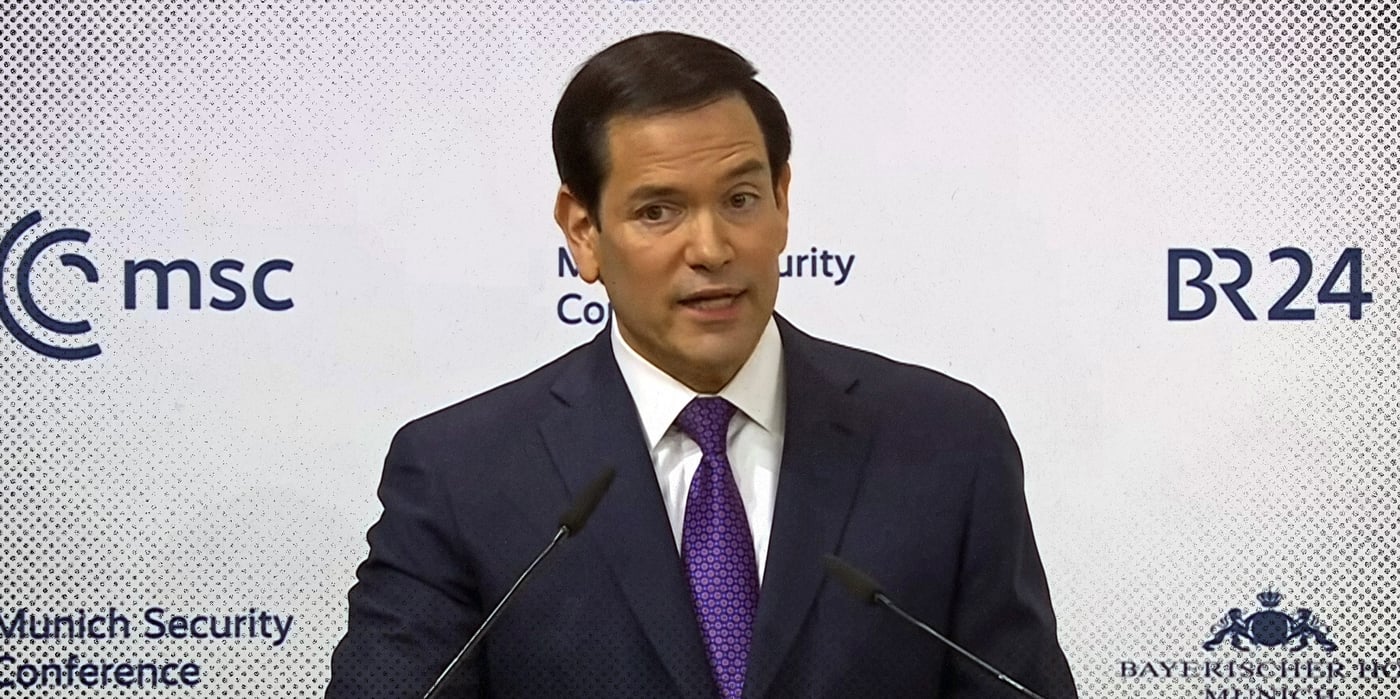

Secretary of State Marco Rubio went to Munich, Germany, over the weekend and proved once again that he is President Donald Trump’s most impressive cabinet member.
Rubio has spent the first year of Trump’s second administration deftly and ably laying out and defending the president’s foreign policy. He did so yet again in a fantastic speech at the Munich Security Conference on Saturday.
New York Post columnist Miranda Devine summed it up: “Rubio drew a standing ovation from the assembled European heads of state, intelligence chiefs, and military leaders for a speech that was no less forceful or frank than VP JD Vance’s address that jarred the same forum last year, but was delivered with a mellifluous voice and calm humility that disarmed even the most arch Euro-socialist.”
Rubio didn’t allow any daylight between him and Vance, though, saying, “I think it’s the same message.”
What was that message? America and Europe are inextricably bound together. Or, as Rubio put it, “Our destiny is and will always be intertwined with yours.” We share the same heritage and have made many of the same mistakes — which need correcting.
Most importantly, Rubio’s thesis was this: “We in America have no interest in being polite and orderly caretakers of the West’s managed decline.”
In this speech, the editors of The Wall Street Journal rightly note, “Rubio is drawing directly from Ronald Reagan’s playbook of ‘conservative internationalism’ — unapologetic about U.S. leadership and the superiority of freedom; anchored by threats to the American people and their interests; wary that diplomacy and commerce by themselves can resolve the world’s differences.”
Here, I’ll quote a chunk of Rubio’s speech because of how he brilliantly laid out our history and where left-wing choices have led us:
That infamous wall that had cleaved this nation into two came down, and with it an evil empire, and the East and West became one again. But the euphoria of this triumph led us to a dangerous delusion: that we had entered, quote, “the end of history;” that every nation would now be a liberal democracy; that the ties formed by trade and by commerce alone would now replace nationhood; that the rules-based global order — an overused term — would now replace the national interest; and that we would now live in a world without borders where everyone became a citizen of the world.
This was a foolish idea that ignored both human nature and it ignored the lessons of over 5,000 years of recorded human history. And it has cost us dearly. In this delusion, we embraced a dogmatic vision of free and unfettered trade, even as some nations protected their economies and subsidized their companies to systematically undercut ours — shuttering our plants, resulting in large parts of our societies being deindustrialized, shipping millions of working and middle-class jobs overseas, and handing control of our critical supply chains to both adversaries and rivals.
We increasingly outsourced our sovereignty to international institutions while many nations invested in massive welfare states at the cost of maintaining the ability to defend themselves. This, even as other countries have invested in the most rapid military buildup in all of human history and have not hesitated to use hard power to pursue their own interests. To appease a climate cult, we have imposed energy policies on ourselves that are impoverishing our people, even as our competitors exploit oil and coal and natural gas and anything else — not just to power their economies, but to use as leverage against our own.
And in a pursuit of a world without borders, we opened our doors to an unprecedented wave of mass migration that threatens the cohesion of our societies, the continuity of our culture, and the future of our people.
We made these mistakes together, and now, together, we owe it to our people to face those facts and to move forward, to rebuild.
That is precisely the point of the Trump administration: to reverse major mistakes of previous administrations and even of allies.
What made Rubio’s speech so warmly received by European leaders — though we’ll see if that leads to any actual changes — was that he gave tough love with a path forward. He reassured Europe that American interests don’t end on our own coastline. In fact, he made the case that the Trump administration’s America First policies and preference for our Christian heritage are due to sharing those features with our European ancestors and allies.
“We are part of one civilization — Western civilization,” he said. “We are bound to one another by the deepest bonds that nations could share, forged by centuries of shared history, Christian faith, culture, heritage, language, ancestry, and the sacrifices our forefathers made together for the common civilization to which we have fallen heir.”
It was as if Rubio were saying, Remember who we are.
We can’t do that if we eliminate borders and allow Europe to become a colony of the Middle East, or if we gut our own industries in favor of the Far East.
“I am here today,” Rubio told them, “to leave it clear that America is charting the path for a new century of prosperity, and that once again we want to do it together with you, our cherished allies and our oldest friends.”
It’s clear that much of Europe is antagonistic toward America and Trump in particular. But overtures like Rubio’s are part of what it will take to chart the path forward.
Video: https://www.youtube.com/watch?v=yOjBJ89aeXA
[Follow Nate Jackson on X/Twitter](https://twitter.com/NatriotJackson).