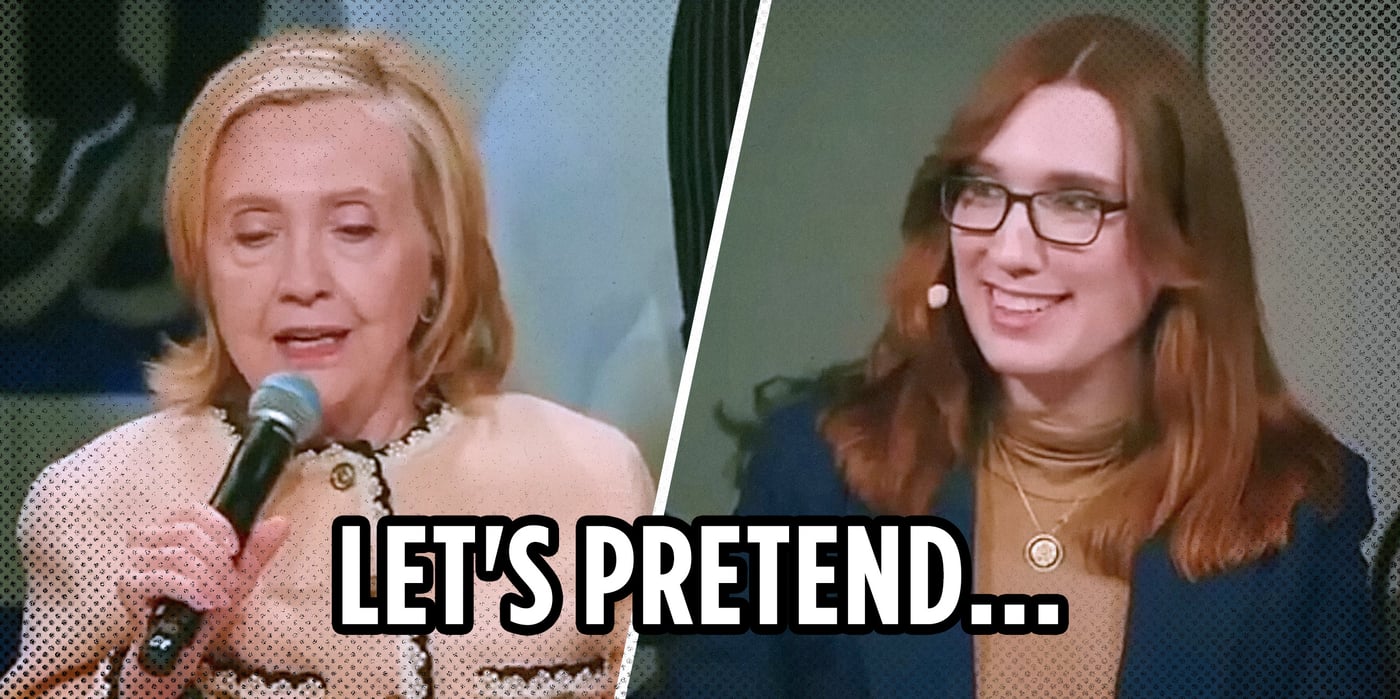

Last weekend at the Munich Security Conference, Hillary Clinton moderated a panel titled “Girls Just Want to Have Fundamental Rights: Fighting the Global Pushback.” For women advocating for protections rooted in biological reality — like single-sex spaces, fair athletic opportunities, and recognition of women’s unique vulnerabilities — the panel, led by a man in a dress, was a stark reminder of how far some progressive circles have strayed.
Instead of sincerely addressing these concerns and framing them as concerns about women, the discussion demonstrated a familiar pattern: preaching empathy and inclusion while sidelining the very voices those principles are meant to protect.
Clinton began by introducing the opening speaker: Tim “Sarah” McBride, the Democrat congressman from Delaware, who sees himself as someone making history in real time, being the first openly “transgender” member of Congress. Clinton misgendered McBride as a “congresswoman” who has been “on the front lines of this fight,” praising his effectiveness in engaging colleagues despite “attacks, even from your fellow members of Congress,” and highlighting his courage in the face of opposition. Clinton also implied that any reference to McBride’s biological sex was threatening to him, effectively warning women in the room to keep dissenting views to themselves.
McBride himself then addressed the audience, warning of a “well-organized, well-funded, right-wing regressive movement” that harms “women of all backgrounds.” He asserted that “threats towards trans people are threats towards all women,” framing opposition to certain gender policies as an attack on women’s rights broadly. Understandably, what many viewed as a clown show of a panel was met with harsh criticism and open astonishment. A discussion supposedly dedicated to girls’ and women’s fundamental rights opened with a biological male, who has not experienced core aspects of female biology, such as menstruation, pregnancy, or the associated physical and social risks, positioned as a primary voice on the subject.
Of course, the arrangement raised questions about whose experiences were truly being centered. Rather than highlighting sex-specific issues such as violence against women, women’s health, or the preservation of female-only spaces like prisons and locker rooms, the discussion shifted to inclusivity debates centered on gender identity. That effectively tells women to surrender their distinct realities to anyone in a dress, and that even discussing women’s issues is far less important than making sure a man with an identity crisis feels included.
As such, it’s clear that this approach achieved the opposite of the conference’s stated goal — diminishing women’s voices rather than elevating them. Women have fought for generations to articulate their realities on their own terms, without having those realities redefined or spoken over by others. Placing a biological male at the forefront of a women’s rights conversation blatantly diverts attention from the very issues that matter most to women. Pushing these concerns aside in favor of a broader ideological agenda risks rolling back progress, returning us to a time when women had to wait for a man in the room to grant permission to speak about the topics that matter to them.
Clinton’s broader behavior at the conference only amplified these concerns. In another session at the same conference, she engaged in a tense exchange with Czech Foreign Minister Petr Macinka. Macinka stated plainly, “I think there are two genders,” describing expansions beyond male and female as ideas that have gone “too far from regular people, too far from reality.” Clinton interrupted to challenge him, asking, “Which gender revolution? Women having their rights?” and later pressed, “How about half of us, can we have our rights?”
Macinka appeared to push Clinton to her limit when she admitted that the pushback made her feel “very, very unhappy.” Yet the concerns clearly fell on deaf ears, as she went on to moderate the women’s rights panel where she used a biological male as a women’s advocate — underscoring a consistent pattern in having no interest in even acknowledging that these ideas are too far for most everyday people.
That pattern of dismissing ordinary voices has been demonstrated repeatedly over the years. Hillary Clinton has always been a prime example of the disconnect between the constant rhetoric from the Left about empathy versus who they really are as people.
In an op-ed published in The Atlantic at the end of January, she accused Team Trump of waging a “war on empathy,” claiming that within MAGA circles, “compassion is weak and cruelty is strong has become an article of faith.” She described the movement as engaged in a “glorification of cruelty” and a “rejection of compassion,” with “savagery” as “a feature, not a bug.”
Such language was apparently meant to position her as a defender of kindness and understanding.
However, her self-declared expertise on being human falls in stark contrast to her well-documented history of demeaning others. These include past dismissals of certain women’s allegations as part of “bimbo eruptions,” her characterization of opponents as a “basket of deplorables,” and suggestions of needing to “deprogram” certain voters — highlighting what seems to be a selective application of empathy to those whom she decides are deserving of it, based on their politics. That selective approach to empathy helps explain why the events in Munich felt so familiar.
The Munich panel underscored a broader pattern in most leftist circles: a relentless eagerness to expand the definition of “woman” to include biological males and snuff out women while claiming to be the experts on humanity, and lecturing on empathy and respect while simultaneously belittling and dehumanizing anyone who has a different perspective.
If those who claim to be advocates for women — or for humanity more broadly — intend to speak authoritatively about women’s rights, compassion, or empathy, a serious approach should begin with clarity about what those terms actually mean, and how they want those things to play out in real life. Until that reflection happens, events like the Munich conference will continue to highlight a widening disconnect between elite platforms fixated on their own voices and the real-world concerns that everyday people want to discuss.