
Russia’s callous war in Ukraine has entered its fifth year. Hundreds of thousands of lives have been needlessly lost on both sides. We are also in an age where the fighting style has changed the game entirely. Drones, artificial intelligence, and satellite-based internet have shaped the war thus far.
Regarding the latter, the Russians had been making good use of Starlink’s jam-proof internet access to guide drones for more devastating attacks, plan the movement of troops and weapons, and communicate quickly and efficiently. The situation was becoming increasingly dire for the Ukrainians as Russia’s military dominance wore down their defenses.
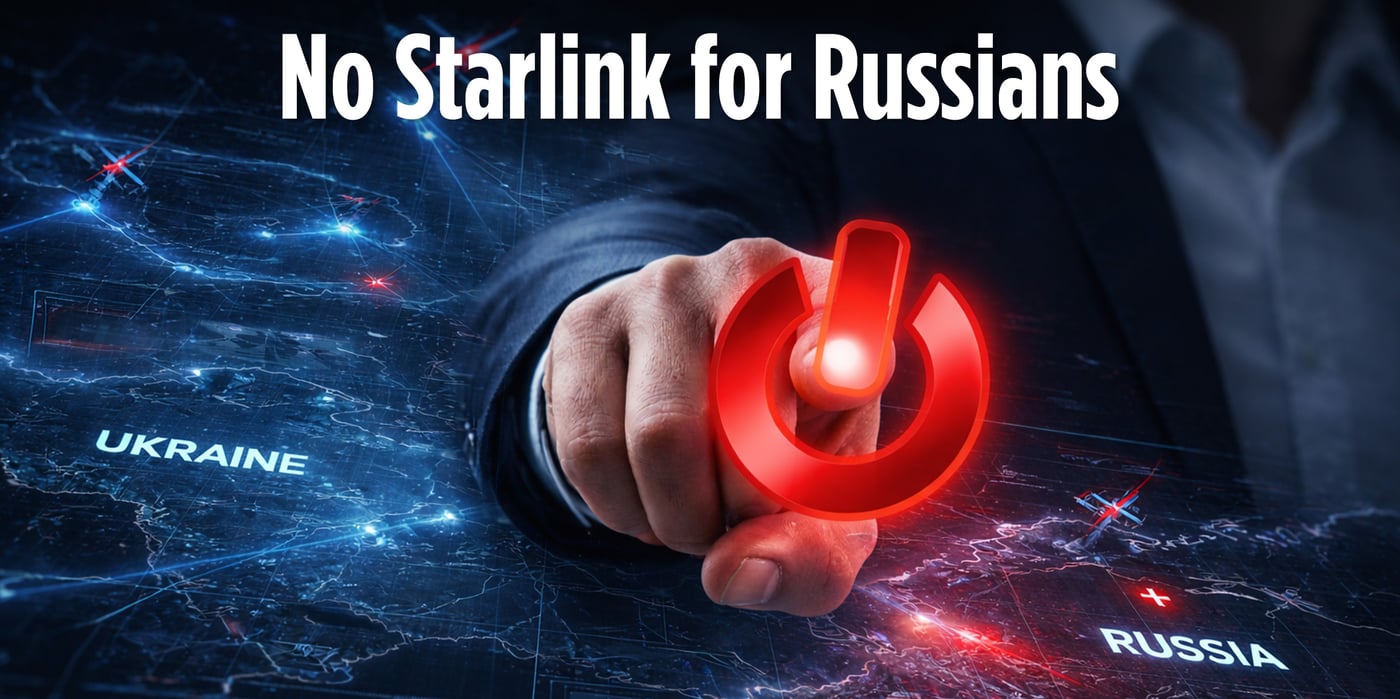
In February, however, Starlink’s owner, Elon Musk, decided to shut off Russia’s access to it, which has shifted both Russia and Ukraine’s offensive measures. According to the BBC, the data shows that Russia has lost its military dominance in the war.
“The Russians ... lost their ability to control the field,” said a Ukrainian drone operator. “I think they lost 50% of their capacity for offense. That’s what the numbers show. Fewer assaults, fewer enemy drones, fewer everything.”
The BBC adds that “in some areas of the long front line, especially east of the city of Zaporizhzhia, there is some evidence of Russian forces being forced to retreat.”
Former Ukrainian intelligence officer Ivan Stupak hopes that his country’s leadership takes advantage. “The Russian armored forces on the ground are partly blind and partly deaf,” he explained. “Maybe they will be so frustrated and demoralized that even a small counter-offensive could be on the same scale as 2022.”
It could even be as demoralizing as Ukraine’s seizure of Russian territory in August 2024.
Meanwhile, negotiations brokered by the United States continue. As of last week, both Russia and Ukraine agreed that Russia had not achieved its war goals by any stretch of the imagination. Ukraine is still free, and Russia is still feeding soldiers into its meat grinder.
After the U.S. and Israel’s joint attack on Iran that took out Supreme Leader Ali Khamenei and dozens of others in the regime, it seems that Russian President Vladimir Putin is doubling down. Many Kremlin hardliners are particularly worried that President Donald Trump’s Operation Epic Fury in Iran means that Russia is next. If that is the case, carrying out Putin’s war objectives is more pressing than ever.
International relations and geopolitics are like playing a chess game on a boat in a stormy sea. The undercurrent is always shifting as powers rise and fall. However, it seems more likely that Trump’s moves in Venezuela and now Iran were more directed at our greatest geopolitical enemy: China.
Russia sees the U.S. as its greatest geopolitical enemy, but the U.S. has bigger fish to fry.
While the Russians have had their weapons, logistics, and intelligence hobbled by Elon Musk turning off Starlink there, in Ukraine, satellite internet is operational and very advantageous. As more time goes by, it will be interesting to see how the Russian army adapts or flails.