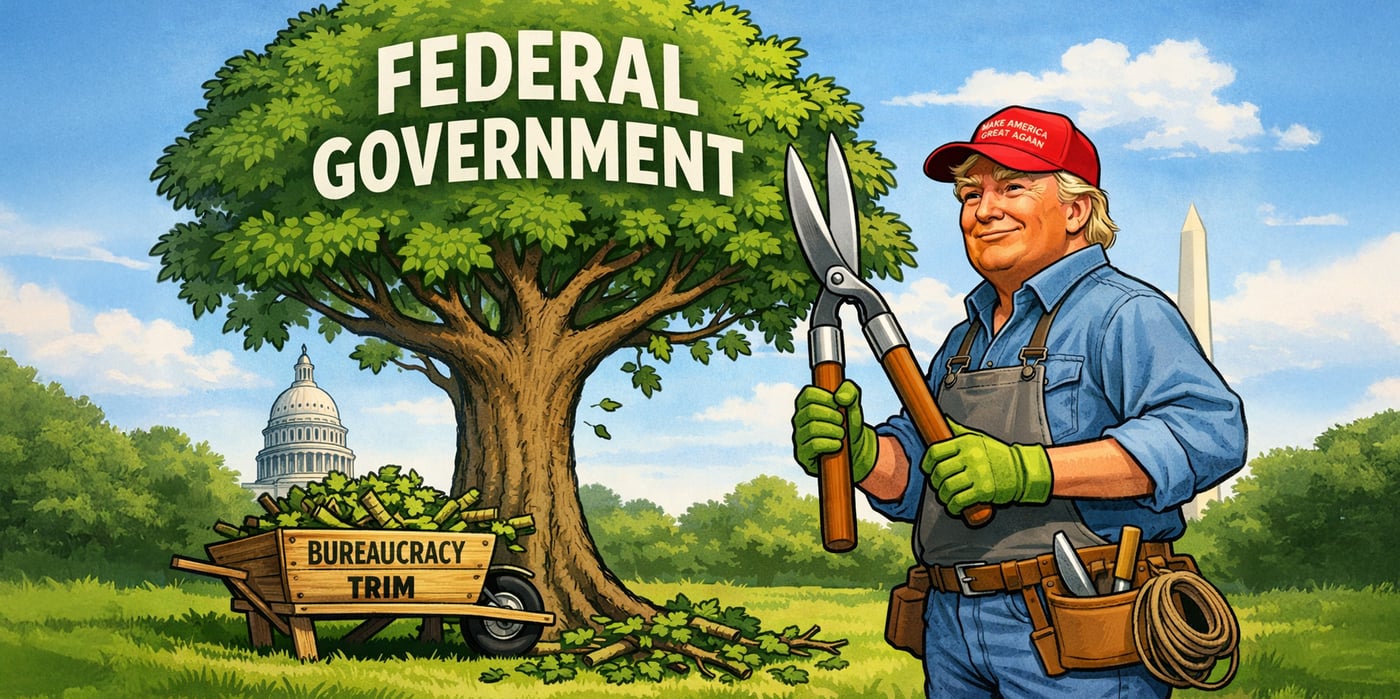

When President Donald Trump returned to office for his second term, one of his big agenda items was a carryover from his first term: draining the DC swamp.
Culling Washington’s behemoth bureaucracy was initially spearheaded by Elon Musk and the newly created Department of Government Efficiency. DOGE quickly went to work at near breakneck speed. Indeed, the Washington establishment hardly knew what had hit it. At the time, Musk boasted that he believed DOGE could trim some $1 trillion in excess government spending. Unfortunately, the massive cuts to government waste and spending were never realized, although some wasteful and needless agencies, such as USAID, were exposed and effectively eliminated.
Leftists certainly caterwauled about money, but most of the loudly raised objections to DOGE’s actions were directly tied to efforts to downsize the federal workforce. The claim was that eliminating thousands of government jobs would negatively affect the federal government’s ability to provide the services American citizens relied on.
Well, here we are a year later, with the Trump administration having cut 386,826 federal workers, according to the Office of Personnel Management. And lo and behold, the government is still functioning. Aside from those former federal employees, have any Americans felt any negative ramifications from the elimination of these positions?
The answer is silence from much of the mainstream media, which had been squawking about it at the time, as if Musk were eliminating the entire federal workforce.
The fact is that the services Americans rely on, such as Medicaid and Social Security, did not experience any setbacks. The Internal Revenue Service, which Joe Biden sought to double in size as part of an effort to shake more loose change out of Americans’ pockets, has found it can still operate without all the extra personnel.
In short, the federal government is humming along just fine.
If anything, downsizing federal employment has demonstrated that total jobs numbers do not equate to higher rates of job efficiency or productivity. It is clear that there were a lot of folks working for the federal government who were apparently doing very little actual work.
Much of this reality can be attributed to the common perception that once someone lands a government job, they have effectively secured a job from which they will never be fired. Given this pervasive view, the incentive to work hard and proficiently is significantly diminished. In this environment, work can easily boil down to little more than punching a clock to get one’s eight hours and then looking forward to happy hour.
Of the nearly 400,000 federal employees who were let go, 92% left voluntarily. This fact alone indicates that many of these employees were likely not very fulfilled in the jobs they were doing (or not doing). Granted, a number of them chose early retirement, but that still doesn’t change the reality that the job wasn’t fulfilling enough for them to want to keep it.
Moving forward, the Trump administration plans to cull another 140,000 federal jobs this year, most of them via the restructuring of various agencies and departments. In the long run, Trump’s impact on the makeup of the federal government will likely be significant and lasting.