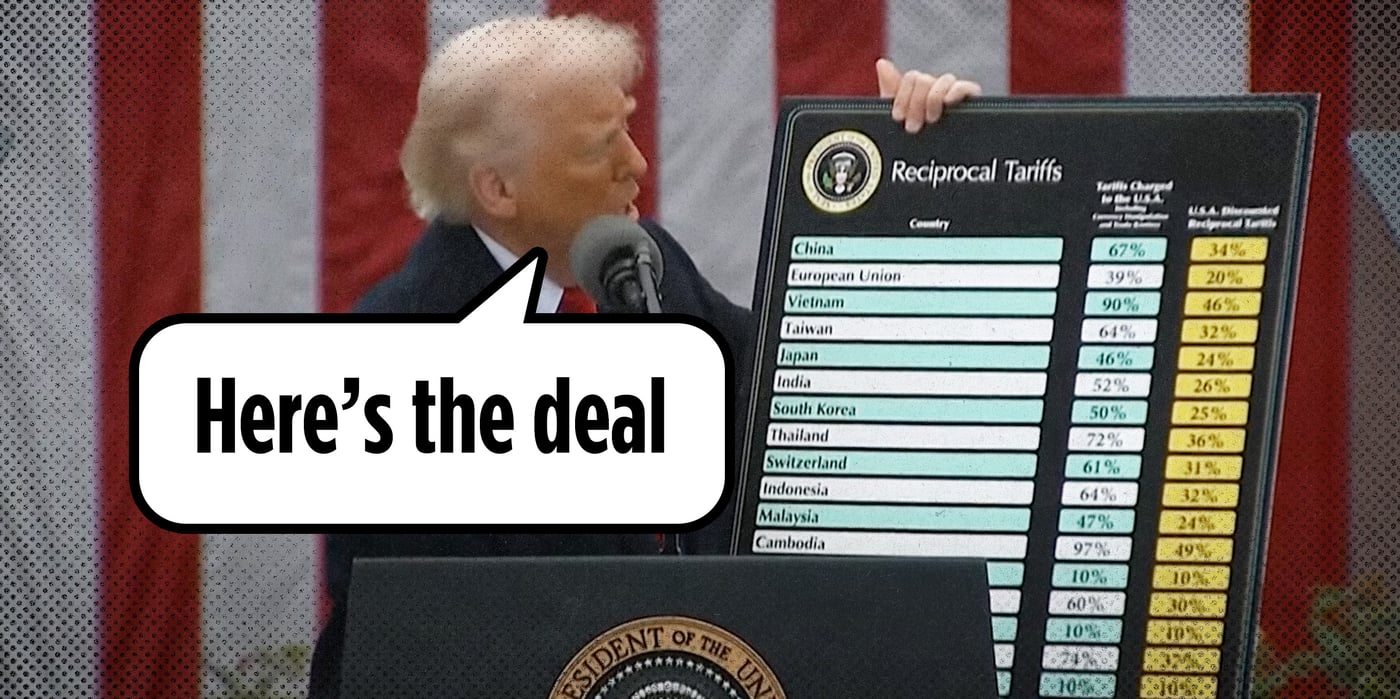

It’s been just over a year since we had what President Donald Trump termed “Liberation Day,” when it was announced that nations around the globe would face much higher tariffs. Liberation Day marked, in Trump’s words, “the day American industry was reborn, the day America’s destiny was reclaimed, and the day that we began to make America wealthy again.” However, most economists were skeptical about the impact on our job market and, more importantly, worried that tariffs could lead to the R-word.
“The president certainly sees these tariffs as an integral part of his America First policy,” our Thomas Gallatin wrote last year. “However, this represents the most significant shift in America’s policy since World War II, and many economists are skeptical that tariffs will bring about what Trump envisions. Indeed, the more pressing concern is whether Trump’s tariffs will trigger a recession.”
Fortunately, the recessionary fears haven’t come true. While it is true that the economy has sputtered at times since Liberation Day, tariffs are not necessarily to blame. Nor have tariffs contributed significantly to inflation: preliminary calculations by advisers to the St. Louis Fed last summer estimated that tariffs were adding less than half a point to the overall inflation rate.
Yet tariff opponents remain impatient for the benefits Trump promised. “Have the tariffs had the glorious effects that Trump and his allies said they would? Hardly,” complained the editors at National Review. “Trump promised on liberation day that jobs and factories would come ‘roaring back’ once a deadened U.S. manufacturing sector was protected from foreign competition. Yet after a year of high tariffs, manufacturing has shed tens of thousands of jobs, continuing a slide that began in 2023.”
Moreover, writing in The Wall Street Journal, former Senator Phil Gramm and George Mason University professor of economics Donald Boudreaux posited that other nations were reaping the benefits promised to us. “Although the average U.S. tariff rate in 2025 approached the level of the infamous Smoot-Hawley tariff of 19.8% for all imports, our trading partners haven’t retaliated against the U.S. so much as pivoted toward other trading partners, initiating the greatest peacetime trade diversion of the modern era. To compensate for lost U.S. markets, they have mutually lowered barriers and increased trade with each other.”
To the extent other nations can do that, it’s all well and good, but ignoring the world’s largest economy will eventually curtail their bottom lines.
Furthermore, Gramm and Boudreaux think they’ve come in for the kill: “Real U.S. gross domestic product grew by only 2.1% in 2025, compared with 2.8% in 2024 and 2.5% in 2017. It is therefore unsurprising that job growth in 2025, at 0.5%, was slower than job growth of 1.2% in 2024 and 1.6% in 2017. Importantly, given Mr. Trump’s fixation on manufacturing, in 2025 the pace of losing manufacturing jobs accelerated to 1.2%, faster than the decline in 2024 of 0.7%. In 2017 manufacturing jobs actually increased by 0.7%.”
Yet the factor they ignore is the significant share of GDP driven by government spending, as well as the shrinking number of government jobs, which affects overall job growth.
Tariffs maintain their defenders, too. Oren Cass opined in the Financial Times, “Countries came to the table rather than retaliating and reached agreements favourable to the US. Inflation slowed, logging an increase in the price level of 2.4 per cent over the past 12 months, as compared to 2.8 per cent for the previous year. Real GDP growth accelerated, up an annualised 2.9 per cent over the last three quarters of 2025, as compared to 2.5 per cent in 2024.”
More importantly, Cass predicts that the manufacturing job growth will come. “Employment is a lagging indicator of re-industrialisation, a process that will take years. No one should expect producers to respond to tariff announcements by going on a hiring spree. Nor is the workforce in place, after decades of neglect, to fill new positions quickly. At the one-year mark, the question is whether the costs and disruptions have been manageable, whether demand and output are up, whether producers are proceeding with investment plans, not ‘where are the millions of jobs?’” For Cass, the indicators are all moving slowly in the right direction, so stay the course. It’s something of a goalpost move from the sell job Trump gave us a year back, but it’s also a prudent take.
“The Trump administration needs to provide a stable tariff regime and pursue permanent legislation so that producers can invest with confidence, and create an intelligible process for facilitating the enormous foreign investment commitments by Japan and Korea. It also needs to prime the talent pipeline for productive workers, with funding for the schools, unions and employers who can get that job done,” concludes Cass.
Regardless of which side you fall on, the reality is that we have shifted away from decades of trying to secure free trade with the world to more of a “fair trade” approach, but trade that’s fair in a way that benefits America at least as much as the other party or parties. Eschewing the old-line Republican and libertarian desire for unfettered trade, President Trump seems to feel that the previous approach allowed other nations to take advantage of our generosity, which they did, and encouraged manufacturing to move offshore, which it did. I remember the factories bailing out of my Rust Belt hometown, some of which popped back up in Mexico or overseas.
The president’s “America First” philosophy takes the opposite tack, with high tariffs in place to protect our industry and used as a negotiating tactic to extract concessions in trade pacts with individual countries. It’s a tactic Trump has put to use with nations around the globe where we have at least reached a framework agreement — even if the Supreme Court created an unwelcome change in tactics, as our Nate Jackson noted back in February.
The biggest issue going forward will be whether America can maintain Trump’s approach. The Supreme Court has already weighed in, and, obviously, the midterms will have something to say about it as well, but one key issue for the 2028 election will be whether the Republican nominee will want to keep tariffs high or ease off the throttle. In turn, that may determine whether nations will accede to our demands or simply wait for a new administration to try their luck — after all, the preceding 80 years of postwar history were good times for the free traders, and the president is trying to reverse all that in a short amount of time.
On this one, though, I wouldn’t count Donald Trump out just yet.