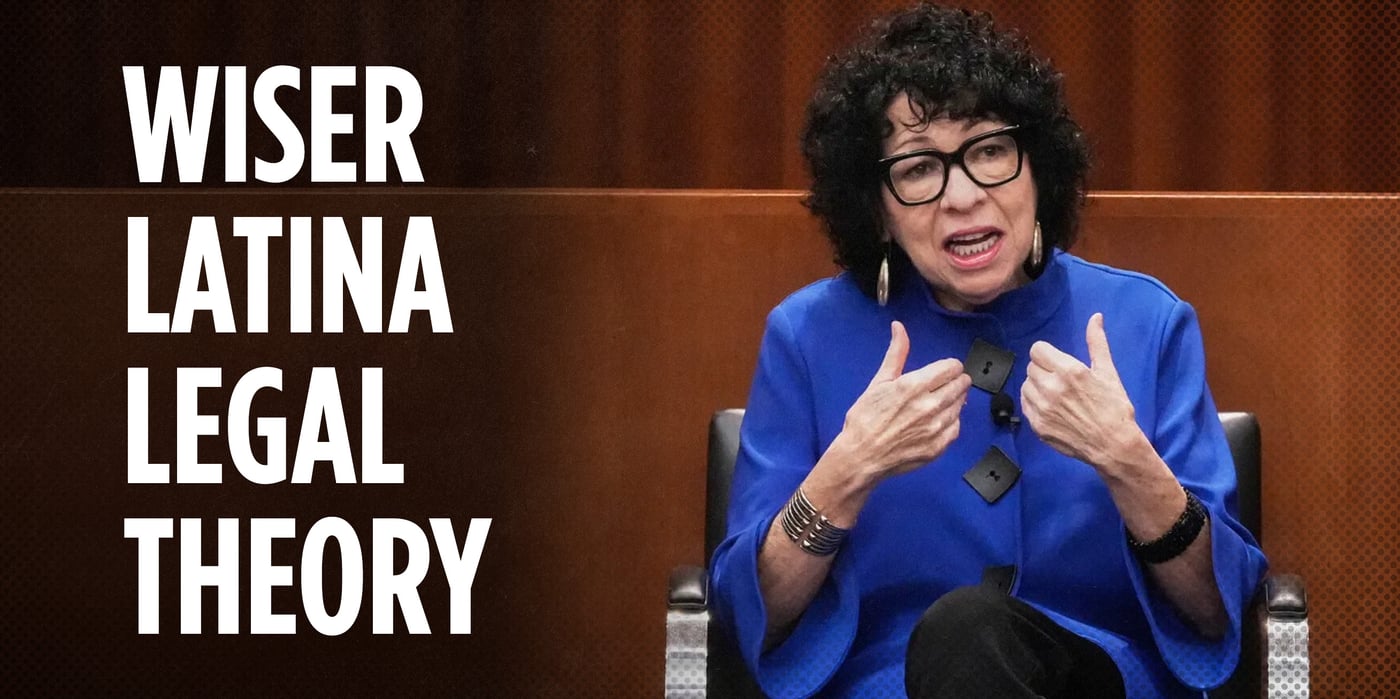

Supreme Court Justice Sonia Sotomayor recently made highly unprofessional and embarrassing comments personally disparaging her colleague, Justice Brett Kavanaugh, albeit not by name, over his legal opinion on the Trump administration’s immigration enforcement practices. Late last week, she issued a public apology.
“At a recent appearance at the University of Kansas School of Law, I referred to a disagreement with one of my colleagues in a prior case, but I made remarks that were inappropriate,” Sotomayor stated. “I regret my hurtful comments. I have apologized to my colleague.”
The comments that got Sotomayor into hot water concerned Kavanaugh’s reasoning in Noem v. Vasquez Perdomo, a case that challenged Immigration and Customs Enforcement’s practice of stopping suspected illegal aliens. In his opinion, Kavanaugh wrote:
Whether an officer has reasonable suspicion depends on the totality of the circumstances. ... Here, those circumstances include: that there is an extremely high number and percentage of illegal immigrants in the Los Angeles area; that those individuals tend to gather in certain locations to seek daily work; that those individuals often work in certain kinds of jobs, such as day labor, landscaping, agriculture, and construction, that do not require paperwork and are therefore especially attractive to illegal immigrants; and that many of those illegally in the Los Angeles area come from Mexico or Central America and do not speak much English.
Sotomayor, who found herself in the minority in that case, apparently believed that what informed Kavanaugh’s legal opinion was not a question of law but rather his own personal identity and privileged status. Why else would she have told the auditorium, “I had a colleague in that case who wrote, you know, these are only temporary stops. This is from a man whose parents were professionals. And probably doesn’t really know any person who works by the hour.”
With those words, Sotomayor not only personally disparaged her colleague’s professionalism and legal ability but also implied that he was motivated by personal experiences rather than by constitutional fidelity and legal expertise.
Ironically, rather than exposing any supposed shortcomings in Kavanaugh, Sotomayor exposed her own biased legal views — views she claimed not to hold when she sat before the Senate during her confirmation hearings.
At her 2009 hearings, Sotomayor was asked to address her 2001 comments in which she implied that minorities were better able to reach just decisions. “I would hope that a wise Latina woman with the richness of her experiences would, more often than not, reach a better conclusion,” she had said. For obvious reasons, senators wanted her to explain.
So, she claimed, “Never have any words I have spoken or written gotten so much attention. ... The words I spoke have created a misunderstanding.” She then sought to clarify, stating, “I was trying to inspire [young Latinos] to believe their life experiences would enrich the legal system.”
Based on her comments regarding Kavanaugh, Sotomayor has clearly not rejected her old race-based identitarian views. Rather than adhering to the judicial standard of impartiality, whereby people are judged solely by their words and actions, not by their racial, ethnic, gender, or social status, she has allowed these identifiers to inform her concept of justice. In practice, her left-wing bias is toward what fellow leftists consider to be inherently disadvantaged groups. The law takes a back seat to considerations of color and “lived experience.”
Unfortunately, these views have gained a foothold within the broader American culture — to the point where Democrats, who used to embrace the classical liberal views of judging individuals as individuals and not by their identities, have increasingly embraced and called for an identity-based “justice” system that is weighted in favor of minority “oppressed” groups. This is the legacy of critical race theory that has infected so much of the West’s academia and is present on the U.S. Supreme Court.