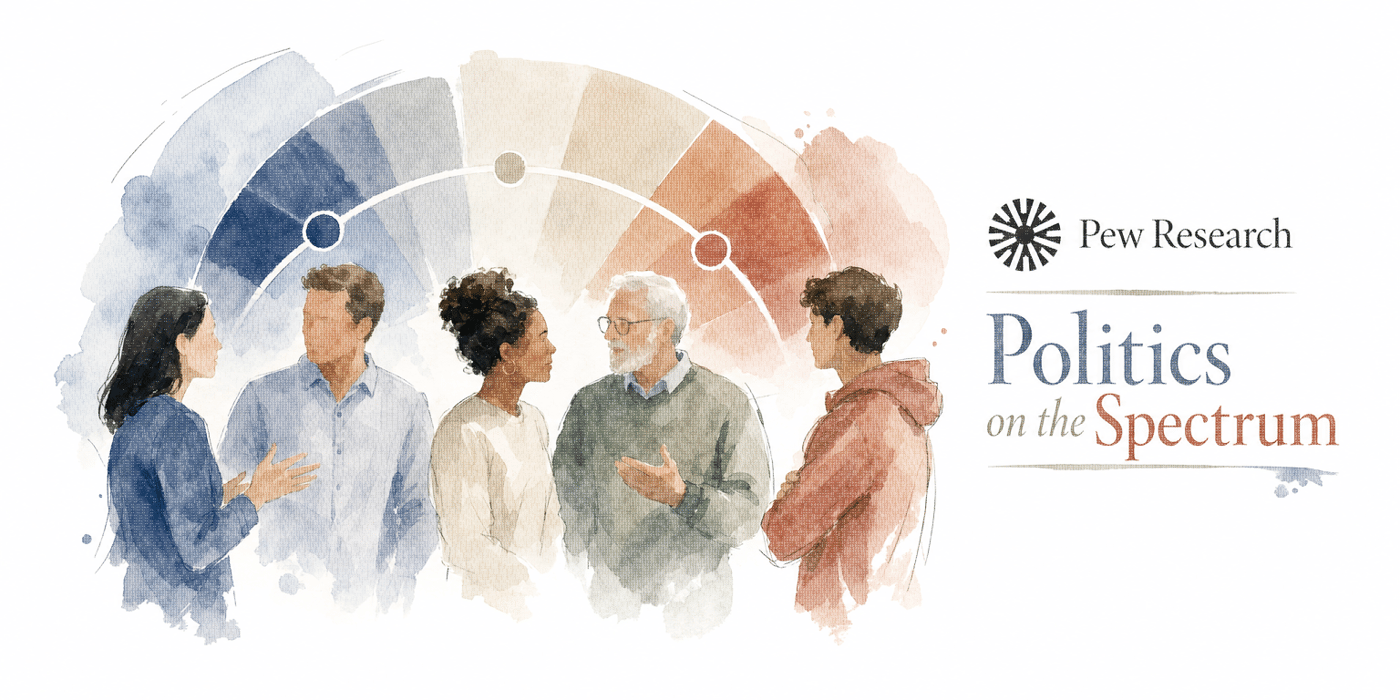

In an attempt to make sense of our political hyperpolarization, the Pew Research Center decided to sort people out based on their “political values.”
Pew surveyed 10,000 Americans and identified nine distinct groups. On the right side of the spectrum, there are the No Apologies Right, the Faith First Conservatives, the Unconventional Right, and the Pragmatic and Polite Right. On the left side, there are the Leftward Progressives, the Loyal Liberals, the Left-Out-Left, and the Order and Opportunity Left. For the independents, the typology assigns them to only one not-so-flatteringly titled group, called “Tuned Out Middle.”
According to Pew, the most extreme groups are the Leftward Progressives and the No Apologies Right. Both of them are the most politically engaged and most likely to vote, which means their polarizing views drive smaller elections like primaries. However, it is the less engaged groups that determine the general elections.
Pew assesses the strengths and weaknesses of each group and seeks to apply them to future elections. For example, Pew describes how the Leftward Progressives are the youngest and most energetic, and that their political values drive policy. However, it cautions that progressives most detest the Democrat Party and would defect to a third party if they thought it would successfully propel them to power.
For the conservatives, the strength of the No Apologies Right is that they are America First. However, their pugilistic style of political discourse is off-putting to just about everybody, yet they don’t seem to care.
The most interesting group described in Pew’s typology is the Order and Opportunity Left. This is a racially diverse and especially large voting bloc that values order and safety; it is not particularly extreme in any of its views except for those that keep the country and its people safe. While these voters do tend to lean liberal, about 25% of them voted for President Donald Trump in the 2024 election.
Pew even included a political typology quiz to help readers assess where they fall on the spectrum.
Pew has some interesting insights, but overall, the grouping is flawed. Putting political ideologies on a spectrum falls into the same trap that all linear political lineups do. For instance, it lumps in political extremists on both sides instead of weeding them out as noisy outliers.
Political typologies would be better represented by a nose ring or a horseshoe because, at the end of the day, there is not much difference between a Candace Owens-type “conservative” and a Hasan Piker-type “liberal.” What ends up happening at the extremes is that Owens and Piker both call America bad, communism good, and the Jews evil.
I took the Pew quiz, and according to the results, I am a Faith First Conservative. I agree. However, I also found that some of the wording was dubious. One question in particular was about whether I believed that the legacy of slavery affects black Americans today. I said yes, because many black Americans use the legacy of slavery as a status of victimhood to push forward racialist policies. However, a more liberal-minded person might interpret an affirmative answer as believing that black Americans are still disadvantaged by the racist legacy of slavery.
This Pew Research survey was an interesting read, and many will no doubt use it as a basis for prognostication about 2026. However, there is a lot of time between now and November. Frankly, if President Trump turns his attention back to the economy and finalizes the war in Iran, that will likely put a happy zing in dissatisfied younger conservative-leaning voters. Time will tell.