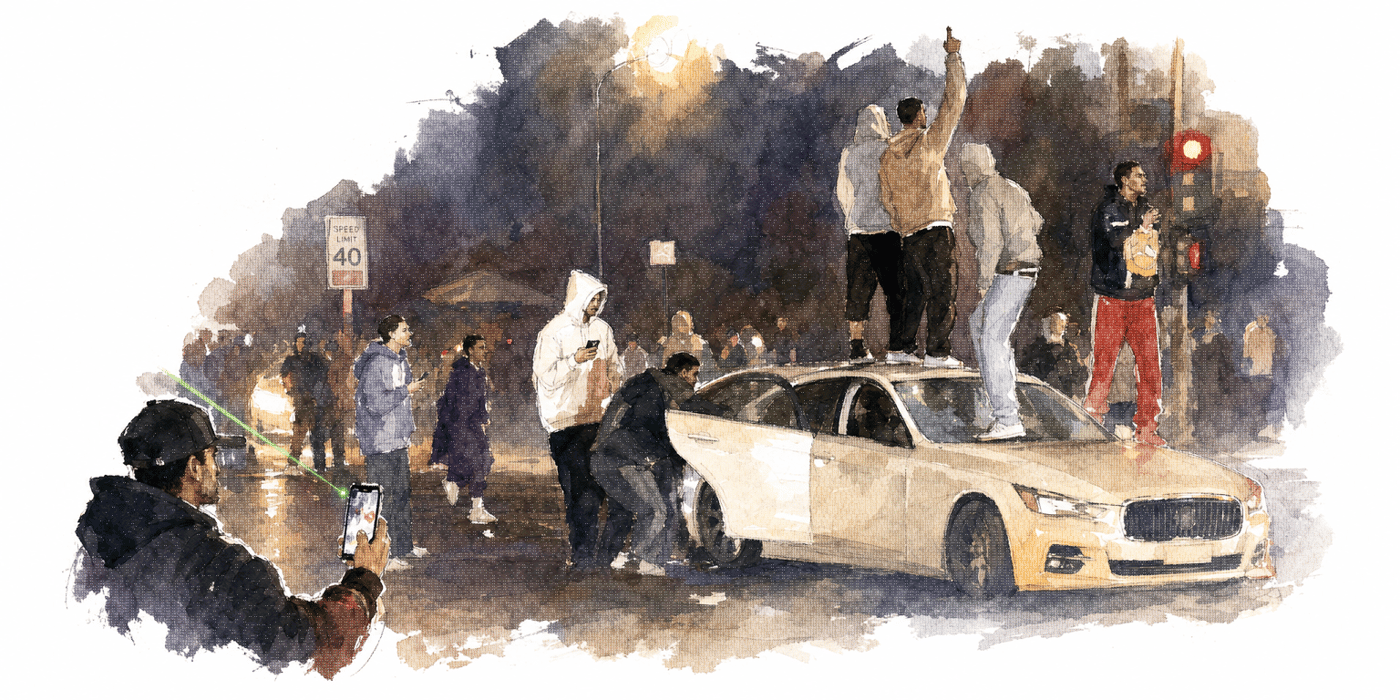

The term “teen takeover” hadn’t yet been invented when candidate George W. Bush lamented “the soft bigotry of low expectations,” but it’s pretty clear that we haven’t learned any lessons in the intervening 26 years — at least not as it concerns unruly and often-violent black teenagers.
Part of the reason for this is that the mainstream media still treats black kids with kid gloves. Take this headline from a lengthy piece by four future Pulitzer Prize-winning reporters at The Washington Post: “‘Teen takeovers’ confound cities struggling to define the problem — and find solutions.”
Huh? The “problem” is that young people, mostly black, are using social media to quickly and surreptitiously gather into mayhem-producing hordes in shopping malls and parks and on roadways and intersections all across America. That’s the problem. Here’s how WaPo’s crackerjack corps reports on a recent outbreak in Raleigh, North Carolina:
What followed was a night marred by disorder and violence, one that police say left nine people injured by gunfire, led to the seizure of nearly a dozen guns, resulted in 29 arrests of young adults and delinquency cases against multiple minors. The scenes soon spread across social media and news coverage of overflowing sidewalks and streets, of shouting and cursing, of blaring sirens mixing with blaring music, of crime scene tape and people face down being handcuffed.
That sounds kind of serious, no? But notice how the passive voice dominates the paragraph. Notice how bad things just sort of happened to people rather than reporting that bad people were responsible for these bad things. Notice, too, how this teenage disturbance “left nine people injured by gunfire” rather than, oh, say, shot. This soft bigotry, this buffering of cold hard truths, this unwillingness to call out the ongoing rash of bad behavior by mostly black teens is of a piece with George Orwell’s essay called “Politics and the English Language,” whereby the soft-peddling of such serious matters “is designed to make lies sound truthful and murder respectable, and to give an appearance of solidity to pure wind.”
Indeed, the WaPo reporters never once mention that these violent mobs aren’t particularly multiracial. Instead, they find a surrogate with a sufficiently black-sounding name to do so: “Almethia Franklin, a sociologist at Concordia University in Chicago.” With this air cover, they can bravely convey Franklin’s incriminating words: “Because it’s Black youth gathering, because it’s Brown youth gathering, we see it as being a threat. It’s a new word, but it carries the same type of responses.”
So what’s the solution? Raleigh’s police chief, Rico Boyce, says the incident was “heartbreaking and unacceptable,” while the city’s Democrat mayor, Janet Cowell, says, “It’s unacceptable and really won’t be tolerated here,” adding she’s not opposed to an “emergency youth curfew.”
I half expected them to start prattling on about “root causes.”
At City Journal, the intrepid Heather Mac Donald produces an exhaustive list of one violent incident after another all across the country, from DC to Detroit to Chicago to less likely places such as Arcadia Lake in Edmond, Oklahoma. Not even Joe Biden’s beloved Rehoboth Beach has been spared. She also notes the disengagement of police in the post-George Floyd era, and who can blame them? In addition, she faults our collective failure, in which “cities and states loosened their already-permissive rules for holding juveniles accountable for crimes.”
Further, Mac Donald notes how Barack Obama fundamentally changed the United States of America in ways that perhaps his voters hadn’t bargained for:
The juvenile-justice system was similarly emasculated in the twenty-first century, for much the same reason as the adult system: to avoid disparate impact. The Obama administration sued school districts for disparities in school-discipline rates between black students and white students. Suspensions and expulsions plummeted. Rather than being punished, insubordinate pupils were directed to “peace circles” and other forms of restorative justice.
Then there’s the race thing. “Left-wing academics and activists are probably right that the sight of thousands of black teens swarming public thoroughfares triggers racial panic among whites,” she says. “But that panic is not irrational. For more than half a century, socialization has failed in large segments of the black population, driven largely by family breakdown.”
Bravely spoken. Are “support programs” and “prevention and intervention programs” the answer? I don’t think so. I think holding folks severely responsible for bad behavior is the answer — even if it sometimes includes holding the parents of these miscreants responsible.
In any case, as Mac Donald concludes, “A natural experiment is being created to test the relative efficacy of government social programs versus law enforcement in curbing crime.”