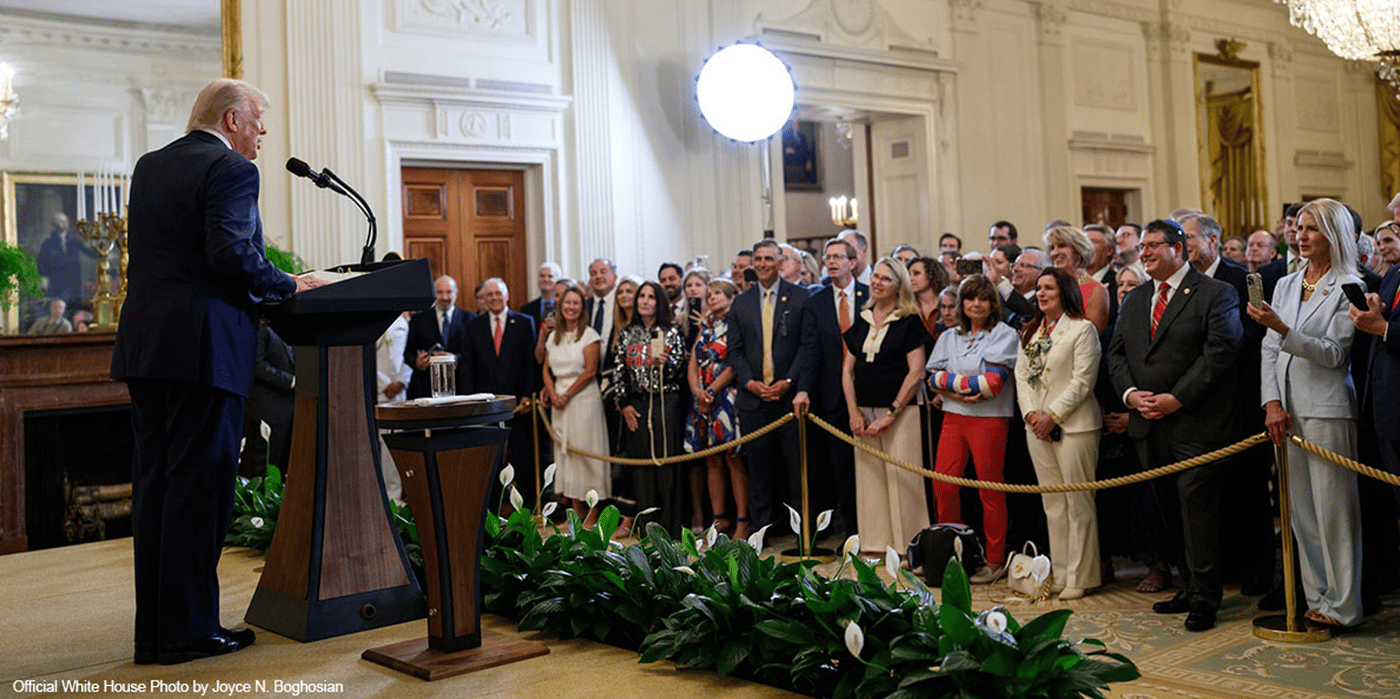

Donald Trump ratcheted up the pressure on Senate Republicans on Wednesday in the aftermath of a dismal night for the GOP brand. And while the election defeats were contained to blue states — where most experts would predict an off-year, off night for the president’s party — the hand-wringing over what this could mean for the majority a year from now has the White House reaching for the panic button. “Terminate the filibuster,” Trump demanded — without bothering to consider if the desperate suggestion would even work.
There’s this misconception swirling in the Republican Party that if we could just end the 60-vote threshold, conservatives could enact everything on their wish list. Even the president has fallen for this legislative fairy tale, painting a pie-in-the-sky picture of Congress doing “our own bills.” “We should start tonight, with ‘the country’s’ open, congratulations!’ Then we should pass voter ID, we should pass no mail-in voting, we should pass all the things we want to pass to make our elections fair and safe, because California’s a disaster, many of the states are disasters.’”
It sounds great, as a Republican majority accomplishing America’s agenda always does. There’s just one gaping problem: who actually believes the GOP would stick together long enough to accomplish it? We’ve just come off a tumultuous few years where the House speaker was ousted by his own party, and his replacement, Mike Johnson (R-La.), has had to ride out intra-party storms that rival Hurricane Melissa. The tougher-than-he-looks Louisianan has had to hold his wafer-thin majority together with diplomatic duct tape — through months of floor tantrums, overnighters, back-stabbing, X wars, threats to his gavel, defections, outrageous demands, and betrayal. And that was just for one bill!
Abolishing the filibuster isn’t like waving a magic wand and everything conservatives want suddenly passes. Remember, we had a 51-vote threshold for Trump’s One Big Beautiful Bill, and it was anything but an easy lift. It means — as the reconciliation process did — that Republicans have to find a simple (a misnomer in Mike Johnson’s case) majority in both chambers to get something to Donald Trump’s desk. If you’ve paid even scant attention to Washington in the last 10 years, you understand what a herculean task that is for this party. Unlike Democrats, who have supernatural powers to keep their party in line when they need to, the GOP is full of personalities, grandstanders, and people with competing ideas and priorities. Suggesting, after recent history, that they’ll suddenly stick together like good soldiers and vote the way Trump wants is pure folly.
If Johnson can survive the bitter infighting that drags on for weeks and manage to send a bill on, say, election reform to the Senate, it doesn’t get easier. Remember, Majority Leader John Thune (R-S.D.) has his own cross to bear in the form of liberal Republicans like Lisa Murkowski (Alaska), Susan Collins (Maine), and other mavericks who like to make a stink on their personal soapboxes. There’s absolutely no guarantee that these rogue senators would get on board with any priority of Thune’s. Worse, they’d have all the bargaining power as leadership desperately tries to sweeten the pot (or weaken the legislation) to get them on board. And if they don’t? Republicans would have destroyed the one tool they’ll have in the minority for nothing.
As Family Research Council’s Quena González warned, “Killing the filibuster would be a disaster. It’s a RINO’s dream.” He’s watched in dismay as liberal Republicans have fought, diluted, or killed bills that include even the mildest pro-life protections like the Hyde Amendment. With a lower threshold, blue-state Republicans and liberal senators would have that much more leverage to hold out for concessions on core values if leadership is desperate to pass something that everyone else in the caucus supports.
And at this point, what has Trump even promised to do with his 51-vote threshold? Has he vowed to pass federal legislation ending late-term abortions? Or crack down on chemical abortion and gender transition procedures? Protect girls’ sports? Expand religious freedom? Reinforce parental rights in education? No. So far, all Americans seem to be getting in this trade for overhauling the entire institution of Congress is “no more mail-in balloting.” And while securing our elections is important, is that enough? What guarantee do voters have that this president, who’s wandered a bit from the social conservatism of his first term, will move from election integrity to the big-ticket items on their to-do list?
“If conservatives, who are never a majority in the Senate, want to retain their ability curb some of the worst excesses of the Democratic Party in the future,” González told The Washington Stand, “even when a few of their liberal fellow Republicans (predictably) want to fold under pressure, they would be wise to follow the lead of those Democrats who, when their party was in the majority two years ago and wanted to obliterate the filibuster, instead looked down-range and thought strategically about the consequences.”
That’s why it’s incredibly disturbing to see senators willing to take this leap, based solely on speculation of what Minority Leader Chuck Schumer (D-N.Y.) might do if Democrats retake the Senate. The mentality taking hold in the GOP seems to be, “Oh, Democrats will kill the filibuster, so we should kill it first.” But remember, in 2022, when Schumer had control, it was his own members who stopped him. When he and Joe Biden wanted to ram an abortion-on-demand through all nine months of pregnancy at taxpayer expense law through the Senate by setting fire to the filibuster, Senators Joe Manchin and Krysten Sinema stopped him. Is there anyone in the Democratic ranks with enough courage to do that now? We don’t know. But John Fetterman (D-Pa.) is looking more sane by the day.
Regardless, making such a profoundly dangerous decision based on the GOP’s best guess of what might happen is a horrible idea for tearing down a 200-year-old rule. And yet, Senators like John Cornyn (R-Texas), Ron Johnson (R-Wis.), and Tommy Tuberville (R-Ala.) seem to be wobbling on a principle that would have been ironclad if they were in the minority.
Americans of all persuasions should be grateful for Leader Thune, who continues to push back against this Trump onslaught by insisting, “There are not the votes there.” It would take, somewhat ironically, 51 senators to set fire to the one wall remaining between the Senate and any hope of cooperation, civility, and bipartisanship. Without it, the upper chamber is just another House — tossed to and fro with the temporary passions and whims of the people and unwilling (and unable) to give the voters who lost any given election a voice.
On “Washington Watch” Wednesday, even a stalwart conservative like Senator Roger Marshall (R-Kan.) seemed tempted by the fool’s gold of bulldozing the last line of defense between America and the tyranny of the majority. “I wish the filibuster was in the Constitution,” the senator admitted to FRC President Tony Perkins, “then it would be next to impossible for the Senate to change it. … I mean, I know people talk about praying for decisions, but I wake up every morning that I would do justice [to these issues]. And truly, I’m torn a little bit trying to decide what the right thing is. If you could guarantee me that the Democrats aren’t going to get rid of the filibuster the next time they’re in control, [then okay],” he said. “… I would prefer to keep the filibuster in place. But if they’re going to change it anyway, should we proceed?” Marshall paused, “If we got rid of the filibuster, then we could make our election secure again. We could basically outlaw mail-in ballots, and we could demand voter ID. So there’s good things. There’s bad things, and I’m truly wrestling with it.”
Then, as if being pulled back from the brink by an imaginary force, the doctor reeled it back in. “I’ve got to, again, admit, a lot of the laws that we pass are bad ones. And what the filibuster does [is] it keeps us from passing even more bad ones. It saves us from ourselves. Other senators have said that the House is like the coffee cup, and the Senate is supposed to be the saucer. We’re supposed to measure twice, cut once. And that’s what the filibuster makes us do. It keeps us from jumping [around on policies] every two years. … So I can think of 100 reasons to defend it.”
As for the Republicans leaning into Trump’s short-sightedness on the issue, Thune was careful. “I don’t doubt that he could have some sway with members,” the leader conceded. “But I know where the math is on this issue in the Senate, and ... it’s just not happening.”
In Trump’s defense, he was never in the Senate. He wasn’t even in politics until he ran for president. So maybe he doesn’t understand the long-term implications of what he’s suggesting. For him, nothing matters beyond his term and getting key priorities of the American people over the finish line. That’s an admirable goal — but in a Congress as closely divided as ours, a next-to-impossible one. And not because of the filibuster — but because we haven’t learned to unite around core ideals as a movement, let alone as a people.
Changing the Senate rules won’t unlock the door to every backlogged GOP policy, as some seem to think. Instead, it will build taller and more formidable walls inside parties — and between them. The flames of division will become an inferno that no minority can put out. So, if you like hyper-partisanship, if you dream of a day when there’s not a single thing Republicans can do to stop the runaway train of radical leftist socialism, then by all means, destroy the filibuster.
But if the goal is to move forward as a country, finding ways to work and talk through issues facing our nation together, this isn’t the solution.
Suzanne Bowdey serves as editorial director and senior writer at The Washington Stand.