
A thousand years ago, the Mongols of China warred upon Japan. Later, Japanese pirates raided Chinese vessels and ports for centuries. China and Japan fought multiple wars for control of Korea. In the 19th and 20th centuries, Japan was stronger and held the upper hand.
Before and during WWII, it is well documented how evil and brutal Japan was toward the Chinese. Consider the “Rape of Nanking,” where Japan mercilessly murdered hundreds of thousands of Chinese and abhorrently practiced using captured Chinese women and even young girls as “comfort women,” which was sexual slavery. The Chinese people remember these atrocities well.
After WWII, the Japanese government tried to make amends by issuing various statements of apology for their earlier depredations. It expressed “deep remorse” and “heartfelt apology,” but these statements have not really assuaged Chinese feelings. China thinks Japan has not done nearly enough to make amends.
Despite lingering tensions, China and Japan have maintained normal diplomatic relations since 1972, and their economies are deeply intertwined. China is Japan’s largest trading partner with ~$295B in trade in 2024: ~$125B in Japanese goods to China, and ~$170B in Chinese goods to Japan. These trade items are critical, including machines and tools in the semiconductor and electronics sectors, autos and automotive parts, factory equipment, and chemicals. Japan is also a major trading partner of Taiwan, with $70B+ in trade, mostly in technology and electronics, and Taiwan is among Japan’s top five trading partners.
The lingering enmity between the Chinese and Japanese includes current-day disputes over Taiwan. Japan ruled Taiwan from 1895 to 1945. China resents that and objects to the support that Japan provides to Taiwan. The PRC’s provocations against Japan include often flying aircraft or sailing its ships near Okinawa, a major part of Japan since its annexation in 1879. China has ancient connections to Okinawa as a “tributary state” to China dating back to the 15th-19th centuries.
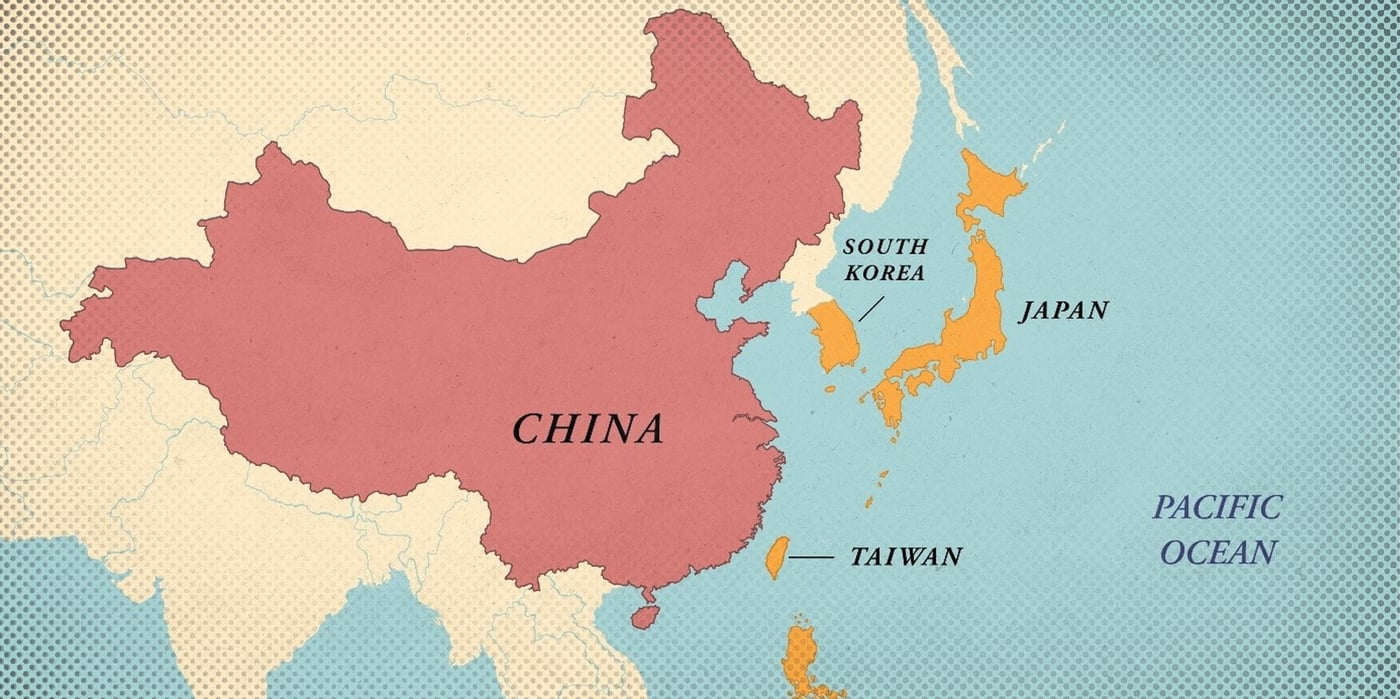
Okinawa’s real importance to China and Japan now lies in the fact that half of the U.S. military assets in Japan are based there, including Navy, Marine Corps, and Air Force bases. Japan is an important treaty ally, so we maintain significant military forces there to defend Japan and, if necessary, Taiwan. China views Okinawa as an unsinkable aircraft carrier hampering its access to the Pacific. The combination of Japan, Okinawa, Taiwan, and the Philippines, known as the “First Island Chain,” puts a stranglehold on Chinese ambitions in the Pacific and beyond. To reach the open Pacific, Chinese vessels must navigate narrow passages. The U.S., Japan, Taiwan, and the Philippines have a big geographic advantage over China, and the Chinese don’t like it.
Taiwan sits less than a hundred miles from the Chinese mainland. Japan’s populated Ryukyu Islands are even closer.
Japan fears a Chinese conquest of Taiwan. A Chinese-controlled Taiwan would only be 66 miles from Yonaguni Island, where Japanese citizens live.
Japan is rightly grateful to America because, after WWII, we spent an estimated $25B on its reconstruction. Some 1.6 million Japanese people now live in the U.S. Japan has the world’s fourth-largest economy, producing 3.7% of the world’s GDP. Foreign trade accounts for 45% of its economy, meaning it depends on reliable, steady trade for a healthy economy. We are a major trading partner, with $80B in exports to Japan and $150B in imports. For its trade to be disrupted by a war on Taiwan by China would be catastrophic. A war in the region would close all major shipping routes, potentially devastating the global economy by the trillions of dollars. The world would descend into a lengthy economic depression.
Japan currently spends 1.8% of its GDP on its military and is rapidly moving toward a goal of 2%. It is investing heavily in anti-ship and standoff missiles, installing U.S. Tomahawks on a destroyer by March 2026, improving radars associated with its Aegis System ships (the U.S. Aegis system), developing unmanned systems, cooperating with Pacific allies on defense matters, and recently signing a frigate deal with Australia, which will build ships for Japan. The Japanese have robust military assets, including four carrier-like aviation ships with F-35B or helicopters, Aegis destroyers, 30+ destroyers of Japanese design, frigates, escorts, and 24 attack submarines. Altogether, Japan has an impressive Navy of 160+ ships. It also has a modern Air Force flying F-15s, Mitsubishi F-2A/Bs, and F-35s for a total of 425+ advanced aircraft. Its modern strike missile assets include both surface-to-surface and air-to-surface types.
Japan conducts frequent exercises with U.S. forces in and around Okinawa, where the already robust American forces are getting even stronger. Japan is a nuclear nation. However, Japan has not developed nuclear weapons. But it has the technical capability to build nukes, and some Japanese advocate their development. If the nation adopts that course, tensions in the region would go even higher. Any attack on U.S. forces in Asia would more than likely bring them into the conflict. Japan is not automatically bound to defend U.S. forces, but to not defend us when we are being attacked, especially if it were to happen to our forces stationed in Japan or Okinawa, would be impossible to avoid.
A war over Taiwan would devastate the local fishing and oil/gas industries. Fishing is vital to all the nations in the region. In any conflict, fishing would be severely disrupted, causing a significant humanitarian hardship for millions. To a lesser extent, the disruption of the region’s robust oil and gas industry would also hurt everyone, with China likely feeling the greatest impact. China depends on oil and gas imports to a staggering degree, with two-thirds of its oil and 25% of its natural gas coming from imports by sea. A sizable percentage of those supplies comes from either the U.S. or Australia, which, in a war, would be completely cut off. Any disruption of either fishing or oil/gas imports would cause China great harm.
Japan is a key partner in the coalition of U.S. allies concerned about Taiwan’s safety and future. Japan’s increasing commitment to its own defense and interests can help protect Taiwan from China’s ambitions.