
“The preservation of the sacred fire of liberty, and the destiny of the Republican model of Government, are justly considered as deeply, perhaps as finally staked, on the experiment entrusted to the hands of the American people.” —George Washington (1789)
It has been gratifying to ignore all the political churn from the chattering class in recent weeks in order to honor our nation’s 250th anniversary of American Liberty.
On Independence Day, I posted one of the most challenging columns I have ever written, “American Liberty’s 250th: ‘A Republic, if You Can Keep It’.” It was monumentally challenging, but only in one sense: How could I adequately honor this Independence Day in one column? That preparation required distilling into a single column the words and thoughts of a lifetime spent affirming and promoting the endowment of Liberty by our Creator and the “unalienable Rights” enumerated in our Declaration of Independence.
Those Rights were codified 11 years later on September 17, 1787, in the Declaration’s subordinate guidance, our Constitution, and like many of you, I have repeated my oath “to support and defend” that founding document many times. (You can read more about the events leading to the creation of both documents in our Primer on American Liberty, and all of the relevant documents in our Historic Documents collection.)
I referenced the notable 250th anniversaries of events in 1775 that set into motion the quest for American Liberty. Those include Patrick Henry’s impassioned “Give me Liberty or give me death” speech, the anniversary of the first Patriots’ Day — the battles at Lexington and Concord that began our Revolutionary War — the establishment of the Continental Army and the unanimous appointment of George Washington as its Commander, as well as the founding of our Navy and Marine Corps.
And on to July 4, 1776. There is so much glorious history — Providential history as Washington would insist — in the years 1775 and 1776, and the decade that followed.
Last week, I diverted from a column on Washington’s Farewell Address to write about the connection between Jon Erwin, director of the outstanding new big-screen release “Young Washington,” and his grandfather Red Erwin, a heroic Medal of Honor recipient.
Returning to Washington’s Farewell meant stepping over other remarkable addresses: his General Orders of 1776, his Speech to Officers at Newburgh, his Letter of Transmittal, his First Inaugural Address, his First Thanksgiving Proclamation, and his Second Inaugural Address.
Notably, the latter was the shortest inaugural address in history, in part because Washington had a difficult time speaking with his primitive dentures, but also because he did not have to say much — his record as the Father of our Country spoke, and continues to speak, for itself.
Of our most noted Founders, Benjamin Franklin was probably the wisest, James Madison the most politically astute, Thomas Jefferson the most intellectually sophisticated, and John Adams the best-read, but they all agreed that George Washington was the greatest among them.
When Washington was 14 years old, he penned a copy of 110 “Rules of Civility and Decent Behaviour in Company and Conversation” in a school notebook. Those rules did not originate with him, but they clearly resonated with him, helping shape his character at an early age.
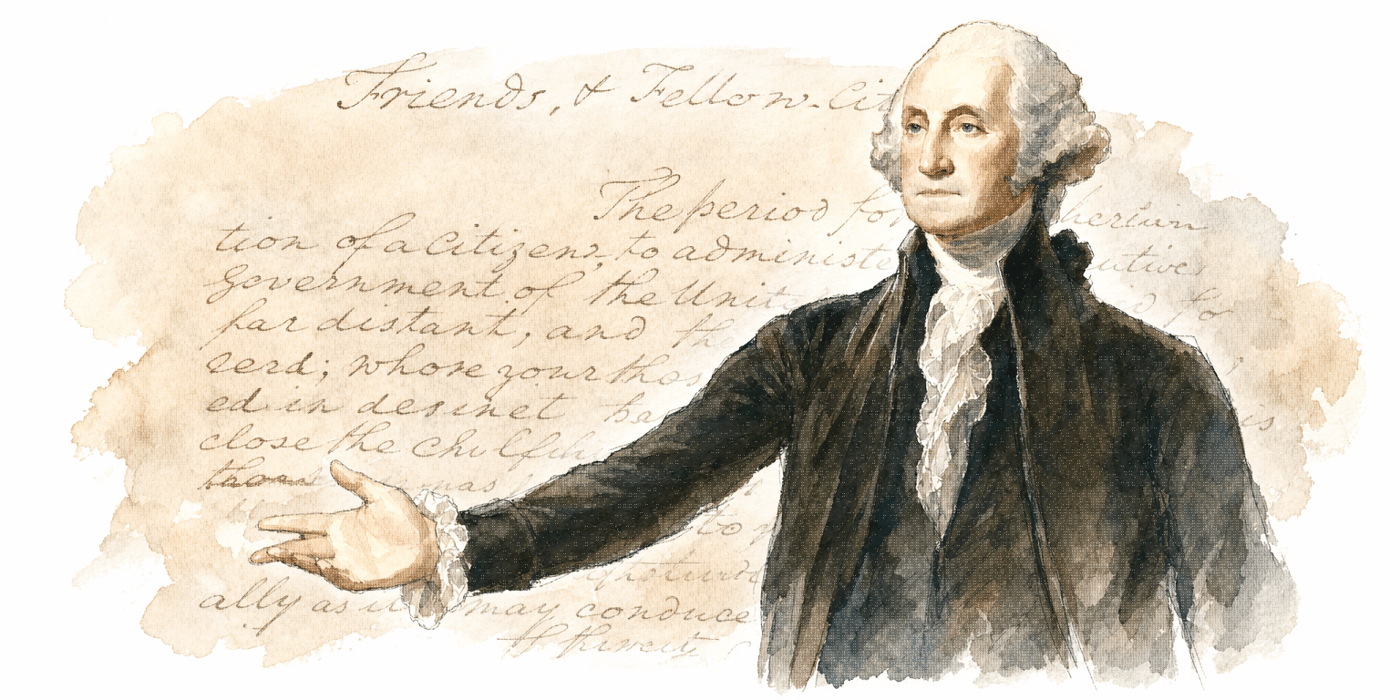
I think those rules were evident throughout his life, and certainly in his 1796 “Farewell Address to the People of the United States,” an early 19th-century copy of which from the Washington Benevolent Society sits next to my desk.
Washington’s leadership was characterized as Primus Inter Pares — First Among Equals, meaning that while he held the highest military and political rank, he generally conducted himself as equal in status, rights, and privileges among those he commanded and served. It is for that reason the American Revolution ended in Liberty, not tyranny, the latter being the fate of the majority of revolutions in history until six “East Bloc” countries threw off their Soviet Union masters in 1989.
It is also for this reason that, at the close of the Revolutionary War and at the end of his tenure as commander-in-chief of the Continental Army, Washington went home to Martha and his Mount Vernon farm. When King George III heard from his American-born portrait painter, Benjamin West, that Washington would retire rather than take power as a sovereign, he replied, “If he does that, he will be the greatest man in the world.”

Washington is rightly called both “The Father of Our Country” and “The Indispensable Man.” He was the model of presidential character. His was not a quest for power and titles; he was governed by strength of character, love of country and family, and, foremost, his devotion to God and American Liberty.
Thus, virtually every word of his Farewell Address is essential to the good order of our Republic today, and to all of its citizens he “recommends your frequent review.”
What follows are some excerpts of his timeless wisdom.
Washington declared, “In looking forward to the moment which is intended to terminate the career of my political life my feelings do not permit me to suspend the deep acknowledgment of that debt of gratitude which I owe to my beloved country for the many honors it has conferred upon me.”
He insisted “that the free Constitution, which is the work of your hands may be sacredly maintained,” adding: “The unity of government which constitutes you one people is also now near to you. It is justly so, for it is a main pillar in the edifice of your real independence, the support of your tranquility at home, your peace abroad, of your safety, of your prosperity, of that very liberty which you so highly prize.”
He advised:
Citizens by birth or choice of a common country, that country has a right to concentrate your affections. The name of American, which belongs to you in your national capacity, must always exalt the just pride of patriotism more than any appellation derived from local discriminations. With slight shades of difference, you have the same religion, manners, habits, and political principles. ... In this sense it is that your union ought to be considered as a main prop of your liberty, and that the love of the one ought to endear to you the preservation of the other. ... This government, the offspring of our own choice ... has a just claim to your confidence and your support. Respect for its authority, compliance with its Laws, acquiescence in its measures, are duties enjoined by the fundamental maxims of true Liberty.
Of political factions, he noted:
All obstructions to the execution of the Laws ... serve to organize faction; to give it an artificial and extraordinary force; to put in the place of the delegated will of the Nation, the will of a party; often a small but artful and enterprising minority of the Community... Cunning, ambitious, and unprincipled men will be enabled to subvert the Power of the People, and to usurp for themselves the reins of Government; destroying afterwards the very engines which have lifted them to unjust dominion. ... The spirit [of Party] is inseparable from our nature, having its root in the strongest passions of the human Mind. ... Without looking forward to an extremity of this kind (which nevertheless out not to be entirely out of sight) the common and continual mischiefs of the spirit of Party are sufficient to make it the interest and duty of a wise People to discourage and restrain it.”
Of faith, he declared:
Of all the dispositions and habits which lead to political prosperity, religion and morality are indispensable supports. In vain would that man claim the tribute of patriotism, who should labor to subvert these great pillars of human happiness, these firmest props of the duties of men and citizens. The mere politician, equally with the pious man, ought to respect and to cherish them. A volume could not trace all their connections with private and public felicity. Let it simply be asked, Where is the security for property, for reputation, for life, if the sense of religious obligation desert the oaths which are the instruments of investigation in courts of justice? And let us with caution indulge the supposition that morality can be maintained without religion. Whatever may be conceded to the influence of refined education on minds of peculiar structure, reason and experience both forbid us to expect that national morality can prevail in exclusion of religious principle. It is substantially true that virtue or morality is a necessary spring of popular government. The rule indeed extends with more or less force to every species of free government. ... Can it be that Providence has not connected the permanent felicity of a nation with its virtue?

Of the necessity of truth and public understanding, he said:
Promote, then, as an object of primary importance, institutions for the general diffusion of knowledge. In proportion as the structure of a government gives force to public opinion, it is essential that public opinion should be enlightened.
Of national debt, he warned:
As a very important source of strength and security, cherish public credit. One method of preserving it is to use it as sparingly as possible, avoiding occasions of expense by cultivating peace, but remembering also that timely disbursements to prepare for danger frequently prevent much greater disbursements to repel it; avoiding likewise the accumulation of debt, not only by shunning occasions of expense, but by vigorous exertions in time of peace to discharge the debts which unavoidable wars have occasioned, not ungenerously throwing upon posterity the burden which we ourselves ought to bear. The execution of these maxims belongs to your Representatives, but it is necessary that public opinion should cooperate.
Of foreign relations:
Observe good faith and justice toward all nations. Cultivate peace and harmony with all. ... Sympathy for the favorite nation, facilitating the illusion of an imaginary common interest … leads also to concessions to the favorite Nation of privileges denied to others ... and it gives to ambitious, corrupted, or deluded citizens (who devote themselves to the favorite Nation) facility to betray or sacrifice the interests of their own country ... gilding with the appearances of a virtuous sense of obligation... Real patriots who may resist the intrigues of the favorite are liable to become suspected and odious, while its tools and dupes usurp the applause and confidence of the people to surrender their interests.
He concluded in part:
In offering to you, my Countrymen, these counsels of an old and affectionate friend, I dare not hope they will make the strong and lasting impression, I could wish; that they will control the usual current of the passions or prevent our Nation from running the course which has hitherto marked the Destiny of Nations. But if I may even flatter myself, that they may be productive of some partial benefit ... this hope will be a full recompense for the solicitude for your welfare.
Washington closed:
I anticipate with pleasing expectation that retreat in which I promise myself to realize without alloy the sweet enjoyment of partaking in the midst of my fellow citizens the benign influence of good laws under a free government — the ever-favorite object of my heart, and the happy reward, as I trust, of our mutual cares, labors, and dangers.
His Farewell is, in sum, the spirit of the generation who bequeathed Liberty to us over the last 250 years, and our responsibility is to carry it forward.
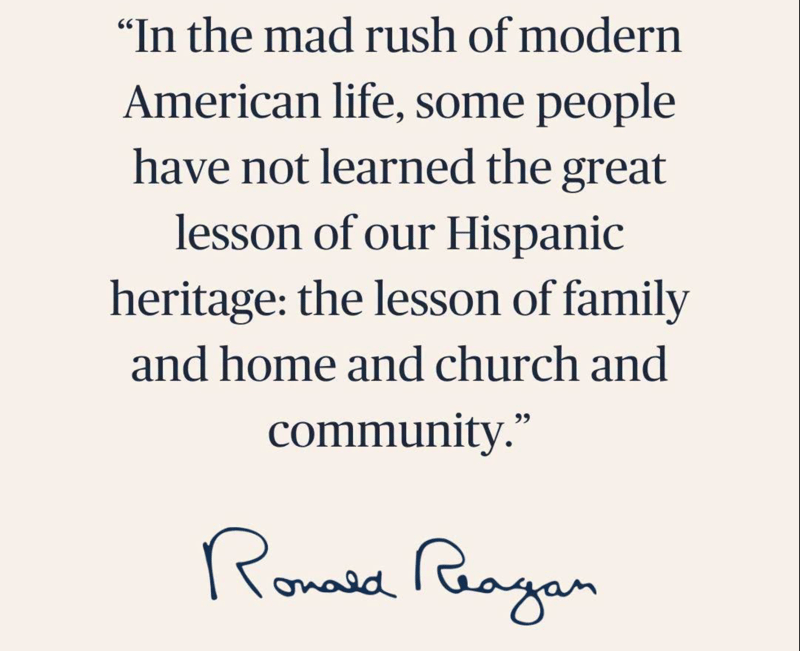
I came of age under Ronald Reagan. It was an era of renewal, when strength, optimism, moral clarity, humility, and faith prevailed as presidential character traits.
I knew then, as I do today, that times have been much worse for our country. In the last century alone, we survived two world wars, the Great Depression, the social and cultural disintegration of the 1960s and ’70s, and other lesser trials. And we began the current century with the 9/11 Islamist attack on our nation.
Likewise, the political factions of the day are ugly now, as they have been in times past.
Yet I am fully confident that, if we abide by the wisdom of George Washington, as President Reagan declared in 1992: “America’s best days are yet to come. Our proudest moments are yet to be. Our most glorious achievements are just ahead.”
I’ll leave you with Washington’s assertion, now The Patriot Post’s motto: “Our cause is noble; it is the cause of mankind!”
Semper Vigilans Fortis Paratus et Fidelis
Pro Deo et Libertate — 1776
Follow Mark Alexander on X/Twitter.
Join us in daily prayer for our Patriots in uniform — Soldiers, Sailors, Airmen, Marines, and Coast Guardsmen — standing in harm’s way in defense of American Liberty, and for our nation’s Veterans, First Responders, and their families. Please lift up your Patriot team and our mission to support and defend our Republic’s Founding Principle of Liberty, in order to ignite the fires of freedom in the hearts and minds of our countrymen.
Thank you for supporting our nation’s premier online journal of Liberty.