
With every passing day, I have more trouble recognizing my own country.
Just this past Saturday night, I was working on my weekly column, this one intended to examine our nation’s distinctly negative societal reaction to the war in Iran. Then, as I was pounding away on my laptop keyboard, my wife interrupted with news that an active shooter had been apprehended at the White House Correspondents’ Association (WHCA) black-tie event in Washington, DC — the annual opportunity for our two political parties to enjoy some lighthearted jousting. Saturday’s WHCA event was attended by the president, vice president, and their wives, along with senior administration officials, media notables, and more than a thousand other guests. Could there be a worse setting for a mass shooting? The very chaos I was writing about — fiercely angry and sometimes violent— had manifested itself yet again.
Today, there is a grand canyon of disagreement separating not just our political leadership but also a large fraction of the populace. The intensity of Democrat opposition to the Trump administration is, in my view, unprecedented — extending well beyond policy debate and into active resistance and, in some cases, full-bore obstruction.
Recently, the political opposition seems to be focused primarily on the war in Iran. But the underlying question is this: Do Democrats truly hate the war? Or do they just hate Trump?
I’d bet it’s the latter. The Trump hatred has been going full bore since day one of Trump’s first term. Sure, there’s much to dislike about war, and in this great nation, we are all free to express our opinions. Democrats and the Leftmedia clearly and openly revile Donald Trump, and they’ve resisted him at every turn. The Iran war is just the most recent excuse.
But for a better perspective on the American public’s love-hate relationship with war, let’s take a look at how it’s played out over the last century and up to now.
World War I was a horror show. While it was clearly “not our war,” we chose with good intent and naive public spirit to lend a hand to our allies — arguably, we broke the stalemate and were instrumental in ending that senseless war — but we sent our American troops into the carnage, and 116,000 never made it home.
In the years following WWI, we became an unapologetically pacifist country, vowing never again to allow ourselves to be drawn into other nations’ insatiable appetite for war. We let our military capability atrophy, underfunded and largely ignored.
For a while, that worked. As ugly as Adolf Hitler’s atrocities were, that was Europe’s problem, not ours. In the Pacific, Japan’s pillaging of its neighbors was a distant rumor across the vast Pacific Ocean. Even as the storm clouds gathered, many in the public were loath to support any action to gird for war. Thankfully, President Franklin Roosevelt recognized the inevitability of U.S. involvement (a critical lesson wholly applicable to Trump’s foresight regarding the threat of a nuclear-armed Iran), and he pushed Congress to initiate the draft, giving us at least a running start at rebuilding an effective military. But it wasn’t until Japan’s sneak attack on Pearl Harbor (“awakening the sleeping giant,” as historians called it) that reality took hold.
Nevertheless, once the war swallowed us, the American public wholeheartedly backed our nation’s participation. The level of accompanying public pain was extraordinary — not just high prices on everything, but large-scale unavailability of everyday needs. And of course, there was the incalculable burden imposed on millions of families ripped apart as young adult males volunteered or were drafted into military service — to fight and die in the war that we’d promised ourselves we’d never permit.
Our WWII involvement spanned four years and claimed more than 400,000 American lives. But unlike WWI, which had been marketed as “the war to end all wars” (it obviously was not), our leadership and military might in that war forestalled the more horrifying sequel — a nuclear WWIII that so many feared.
Can we even imagine the world today if our nation had hidden behind our oceans, hoping against hope that it would all work out? Sometimes, war is the right answer.
In the years since WWII, we’ve been reminded regularly of the ugliness of war. Vietnam was the ugliest for sure — another war that was not ours to fight, one that began with providing modest assistance to a beleaguered ally but morphed into a decade-long bloodbath claiming more than 57,000 American lives. And post 9/11, we’ve engaged in largely unsatisfying engagements in Afghanistan and Iraq, both of which took on the feel of meandering, unfocused “forever wars.” It’s no wonder Americans still hate war.
But Iran is another story altogether. In our determination to avoid war, we’ve tolerated acts of terrorism by Iran and proxies that have taken thousands of lives, Americans included, and destabilized the entire Middle East. And Tehran’s dogged pursuit of nuclear weapons presages designs for far greater atrocities worldwide.
Does anyone truly believe that the world order could survive with a nuclear-armed Iran? Who thinks that problem would solve itself if we just looked the other way and hoped for the best?
Evidently (and thankfully), Donald Trump does not think so. Hence, his war of choice against Iran, which in turn has unleashed a torrent of fierce political disagreement, ridicule, criticism, and outright opposition. And reflecting the left-wing media coverage, most public polling on the war has been negative as well.
Public anxiety and instinctive dislike of war are understandable. But to this point, the broadly negative reaction to the war in Iran has in many respects been the polar opposite of that even in our pacifist-leaning country 80 years ago, upon our entry into WWII. Consider:
- Once upon a time, political divisions stopped at the water’s edge. No longer. Last week, we were treated to media clips of two prominent elected Democrat leaders — Connecticut Senator Chris Murphy and Minnesota Governor and former VP candidate Tim Walz — both ridiculing our president and his actions at an international conference in Barcelona.
- Democrats openly advocate for extreme measures to remove Trump from office. They promise impeachment (number three, and perhaps others to follow) on day one of their expected post-midterm return to majority in the House later this year, and they advocate for invoking the 25th Amendment process for removal of an incompetent president (this from the outfit that professed to be comfortable with the clearly declining Joe Biden).
- While we’re at war with the world’s number one exporter of terrorism, our Department of Homeland Security is unfunded — meaning that many of those whom we U.S. citizens rely upon to protect us from terrorist attacks have been working without pay (and in some cases have been forced by economic reality to stop working), all thanks to Democrat senators who place higher priority on showcasing their disapproval of ICE. Disgraceful.
- The culture of political violence continues to take root here in our country, with far too many horrifying examples. The Charlie Kirk assassination prompted a few short-lived vows to tone down the hateful rhetoric, but evidently the Left has made the conscious choice to continue the barrage unabated — and poof, this past Saturday night, another calamity was narrowly averted.
The larger perspective, of course, is that, as much as we Americans dislike war, this one is necessary and certainly legal, and the president’s decision to move ahead, with the criticism sure to follow, was a politically courageous one.
In short, never has there been so furious, so irrational, and so wholly political an objection to necessary military action as we see today. As results begin to look positive, many leftists are scrambling to snatch defeat from the jaws of victory — or at the very least to ensure that their political nemesis, the hated Mr. Trump, derives zero credit.
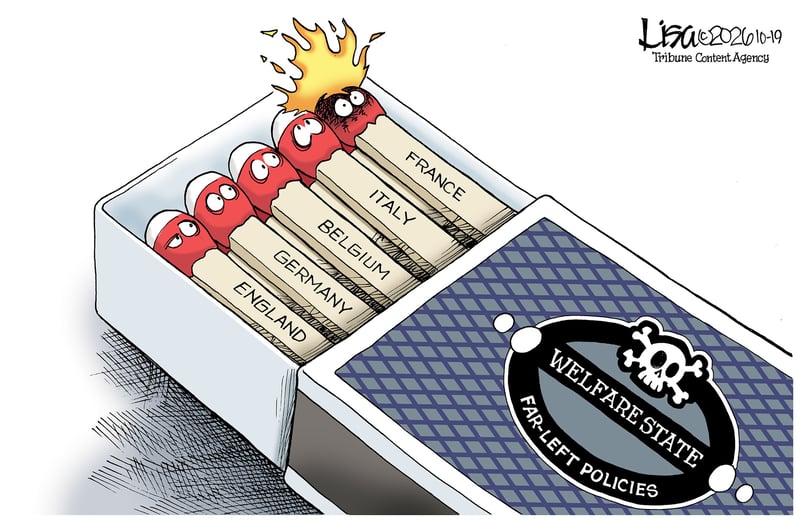
So be it. But they’re playing with fire, making our nation and the world less safe — and making our beloved country harder to recognize.